What The Chariot means in tarot — and in love
The Chariot in love is determination: pursuing the person, fixing the distance, refusing to let the relationship stall. As feelings, the Chariot means they feel driven toward you — ambitious about you, honestly.
Jump to FAQAt a glance
- Yes or no
- Yes — reversed flips it
- Upright, in a line
- determined pursuit, taking control of the situation
- Reversed, in a line
- pushing too hard, a connection pulling in two directions
Want a yes or no on your own situation rather than this card? Pull one card and get the verdict with the reason behind it.
Ask your own yes-or-no questionUpright in love
The Chariot in love is determination: pursuing the person, fixing the distance, refusing to let the relationship stall. It rewards direction — knowing what you want and driving toward it. Long-distance love, a decision to move cities, a bold declaration: all Chariot territory. Grab the reins; this connection responds to motion, not meditation.
What the card describes underneath the motion is control of yourself, not of the other person. The charioteer's problem is that his two animals want different things, and the entire art of the card is going somewhere anyway. Applied here, that is usually about your own contradictions: wanting closeness and wanting to stay untouchable, wanting them to choose you and refusing to ask.
In a new connection it means one of you is going to have to steer. The situation will not develop through ambient goodwill. It develops because somebody proposes a specific day, states an intention plainly, or crosses a physical distance on purpose. This is the least mysterious card in the deck about what happens next. What happens next is whatever somebody does.
In an established relationship it usually shows up during a campaign — a move, a hard year, a shared goal that needs both of you pulling the same way for longer than is comfortable. It is a good card for exactly that. What it is bad at is the slow, unstructured, purposeless part of being together, and couples who run on this energy for years often find they have become excellent teammates and forgotten how to be anything else.
What it asks of you is a decision followed by movement within days, not weeks. Small and real beats large and planned. Book the flight, send the message, name the thing you want. The card has no advice at all for people who are waiting.
Reversed in love
Reversed, the Chariot is a relationship pulling in two directions: mismatched goals, one person racing while the other brakes, or force applied where feeling was needed. You can't drag someone into love at speed. Park, talk, re-align the horses — or accept you're driving alone.
The commonest version is not aggression. It is effort spent in a direction the other person never agreed to. Somebody is working extremely hard — planning, pursuing, fixing, arranging — and none of it is landing, because the problem was never a shortage of effort. Force is the wrong tool for a situation that needed a question.
In a new connection reversed often means the pace is being set by one person alone. Intensity gets mistaken for momentum. It looks like things are moving, and then you notice every single move has been yours and that the other person has been agreeable rather than active. Agreeable is not the same as interested, and this card reversed is frequently the moment that becomes visible.
In an established relationship it points at two people with different destinations being very polite about it. One wants the city, the other wants the quiet. One is building toward something the other has already privately decided against. All the energy goes into the effort of moving rather than into the argument about where, and the effort feels productive, which is what lets it continue for years.
The instruction reversed is to stop and check the direction before spending any more force on the speed. Going the wrong way faster is not closer to anywhere. That is the one thing this card reversed is completely unambiguous about.
The Chariot As feelings
As feelings, the Chariot means they feel driven toward you — ambitious about you, honestly. Expect initiative: plans made, distance crossed, obstacles treated as puzzles. Desire with a steering wheel.
The emotion in this card comes with armour on. Wanting is present and so is control, and a person under this card would generally rather do something about how they feel than describe it.
If you are single and asking about someone new. They want you, and they are already forming a plan. Expect action rather than confession: a specific invitation, an obstacle removed, a distance crossed without being asked. The armour is worth knowing about, though. They will pursue confidently and defend hard against being seen to need anything, and both of those arrive in the same person at the same time.
If you are in a relationship. They feel committed and mobilised, often about something outside the two of you — a job, a move, a plan they consider to be for both of you. The feeling is real. What can go missing is softness, because a person in campaign mode treats the relationship as secure infrastructure and puts their attention on the front line.
If you are asking about an ex. The pull is still there and the wheel is still in their own hands. They will not arrive slowly or ambiguously. If they come back it will be a decision executed at speed, and if they do not, they will hold the line without any visible wavering.
If you are asking about someone long-term. You are what they are driving for. In a long partnership this card means you are not a question in their mind. You are the destination they organised the route around.
The Chariot For your ex
For an ex, the Chariot asks who left whom at what speed. It often means they still feel the pull but pride keeps their hands on their own wheel. If they come back, it will be decisive and fast — no slow fades.
That is the practical value of drawing this card here: it rules out the most exhausting scenario. Whatever happens will not be a six-month blur of ambiguous messages, because a person under this card does not operate that way. They will either arrive with a plan or they will not arrive.
The card also raises the question of what the direction was. An ending under the Chariot is usually one where somebody drove away — a decision made and executed, a departure with momentum behind it. Departures like that are hard to reverse, not because the feeling is gone but because reversing means publicly conceding the decision was wrong, and this is not a card that concedes easily.
If you are the one who wants contact, it has an unglamorous piece of advice. Whoever holds the reins moves first, and waiting to see who cracks is a game this card wins every time. Decide what you actually want, do the specific thing, and accept a clear answer either way. Ambiguity is the one condition this energy cannot survive in, which means asking directly will produce a result even when the result is not the one you were hoping for.
What The Chariot means in general
The Chariot is willpower harnessed to direction. Two sphinxes pull in opposing directions and the charioteer holds no reins — he moves them by focus alone, which is the card's entire argument: contradictory forces do not need to be resolved, they need to be driven. Upright it is momentum, control regained, a campaign pushed through by refusing to be diverted; victory here is won on determination rather than on being right. Reversed the vehicle is off course — force applied without steering, aggression standing in for strategy, or the sphinxes winning, so the situation moves in two directions at once and arrives nowhere.
He is the seventh card, and the sevens of the deck are all about holding a position under pressure. This is the one that holds it while moving.
In work he is the project carried through by one person's insistence, and the campaign that succeeds because nobody was allowed to renegotiate the goal halfway. In money he is the disciplined push toward a target: effective, and narrow. In creative practice he is the piece that got finished by force of schedule rather than by inspiration — a real method, and one that produces more completed work than waiting does.
The cost is specific and the card does not hide it. A campaign requires that some questions stay closed. Everything the driver was not thinking about is still there when he stops, and the reversed card is very often just the moment of stopping.
The other thing to notice is that nothing visible propels this vehicle. No road, no harness, nothing pulling. Whatever motion exists comes out of the driver, and that is the whole claim: direction is not a resource you find, it is one you supply. The card is silent about whether the direction is any good. It says only that a situation where somebody has decided where to go behaves entirely differently from one where nobody has.
The Chariot as a yes or no
As a yes or no, the Chariot upright is a yes, on one condition: somebody has to drive. This is not a card of things that happen to you. It confirms that the outcome you asked about is achievable, and states that it will be achieved by effort, direction and a refusal to be diverted rather than by luck or by waiting.
That makes it one of the more honest yes cards in the deck. It gives you the answer and the price in the same breath. If you are willing to do the moving, yes. If the question was really whether this will resolve itself while you stay where you are, the same card is a no, and it is the same card either way.
Reversed it reads as no, usually with a diagnosis attached. Effort is being spent in the wrong direction, two forces are pulling against each other, or somebody is trying to force a result that needed a conversation instead. It is rarely a permanent no. It is a no to the current approach, and the difference matters, because a reversed Chariot generally responds to a change of route rather than to an increase in speed.
For questions about whether a particular person will act, this is one of the better cards to draw. Whatever they decide, they will do it visibly and at a recognisable speed. You will not be left wondering for very long.
The Chariot as advice
As advice, the Chariot says: pick a direction and move this week. Not the perfect direction. The card is explicit that motion in a chosen direction beats a stationary search for the correct one, because a moving situation gives you information and a stalled one gives you nothing but more time to think about it.
Concretely: name the single outcome you want, out of the several you have been keeping in play. Do one irreversible thing toward it in the next few days — book the ticket, send the message, give the notice, ask the question that cannot be unasked. Then stop consulting people. This is a card about refusing to be diverted, and most diversion arrives disguised as reasonable advice.
The harder half is internal. The two animals pulling opposite ways are almost always two parts of you, and the card's method is not to reconcile them. It is to move while they disagree. Waiting until you feel unanimous about a decision is a permanent condition, not a stage you pass through.
The one thing the card advises against is force applied to another person. The charioteer controls the vehicle. He does not control the road, the weather, or anybody else travelling on it, and the reversed card is what pressure applied to a person looks like from the outside.
Set a date. Whatever you have been deciding, give it a deadline that you have said out loud to somebody, and let the deadline do the work your deliberation has not been doing.
The Chariot as an outcome
As an outcome, the Chariot means arrival. The situation gets where it is going, and it gets there because somebody kept it pointed one way long enough. Expect the ending to be reached rather than received: a result earned by effort, on a timeline set by whoever was doing the driving.
It is a fast card as outcomes go. Things resolve at a visible speed and the resolution is usually unambiguous — a move made, a distance closed, a contest won. It also tends to change your circumstances rather than your feelings. The Chariot delivers a result, not a reconciliation.
In a question about two people, the upright outcome is progress achieved by initiative. Somebody makes the move, the situation advances, and the advance holds. Worth knowing: the card describes the arrival and not the living-with. What happens after it stops is the business of whatever card sits beside it.
Reversed as an outcome means arriving somewhere you did not intend, or not arriving. Sometimes the situation exhausts itself: a great deal of effort spent, no ground gained, the two forces cancelling each other out. Sometimes there is a collision — force meeting force, a decision executed at speed straight into a wall it could have seen coming. And sometimes the outcome is simply a stop, which this card treats as a defeat and which frequently is not one. Stopping is the only way to find out where you had actually been heading.
What the The Chariot card shows
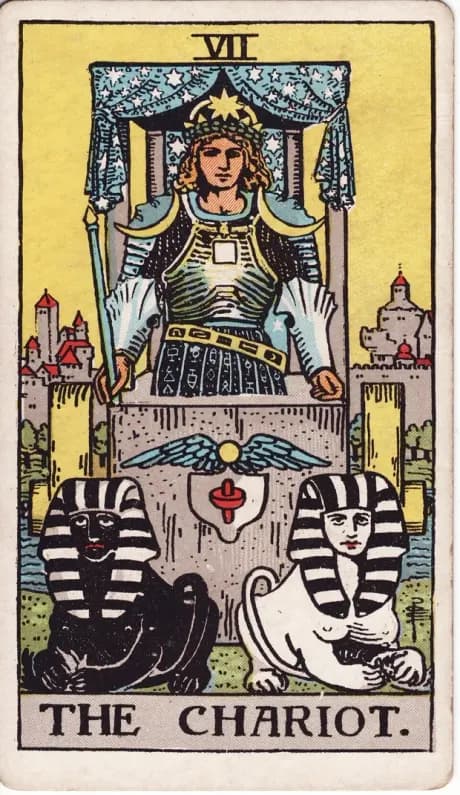
The 1909 card shows an armoured figure standing upright in a square stone chariot drawn by two sphinxes, one white and one black. He wears a golden crown topped with an eight-pointed star, and a blue canopy scattered with white stars is stretched above him. Behind the chariot are a river and a walled city he has already left.
The first thing to look for is what is missing. He holds no reins. Nothing connects him to the two animals in front of him, and they are facing very slightly different ways. Whatever keeps them moving together is coming from him and not from any equipment, which is the card's entire proposition stated as a visual absence.
He carries a wand in his right hand, the same instrument the Magician holds, and on his breast is a square: the emblem of matter, and of things that have been given a fixed shape. Two crescent moons with faces sit on his shoulders like epaulettes. The moods are on him. He is not steering by them. His skirt is marked with symbols and his belt with planetary signs, the influences he carries worn as clothing rather than consulted.
On the front of the vehicle is a winged sun disc, and beneath it a small red and blue emblem of union: the two opposites already joined on the bodywork he stands behind.
The sphinxes are at rest, legs folded under them, and nothing in the picture proves the chariot is moving at all. This is either the instant before motion or motion so controlled it looks like stillness, and the card leaves that open. Both readings say the same thing about the driver. Everything depends on what he decides, and none of the machinery will decide it for him.
Frequently asked
Is the Chariot a yes in love readings?
+
Yes, if effort is on the table. The Chariot promises victory for the one who actually moves — not for the one who waits beautifully. It confirms that the outcome is reachable and says plainly that reaching it depends on somebody deciding and then doing something, which is good news if you were planning to act and bad news if you were hoping to be pursued.
What does the Chariot mean for long-distance relationships?
+
It is the long-distance card: willpower, plans, and miles crossed on purpose. Distance loses when both drivers steer the same way. What it asks for is specifics — a date, a ticket, a stated plan — because this energy does not survive on intention alone. Reversed, it usually means one person is doing all the travelling, in both senses of the word.
Is the Chariot a yes or a no?
+
Upright, yes, conditional on someone taking the wheel: it is a card of results achieved rather than results received. Reversed it is a no to the current approach rather than a permanent no, usually because force is being applied in the wrong direction — and it tends to respond to a change of route rather than to more speed.
What should I do when I draw the Chariot?
+
Choose one outcome out of the several you are keeping open, and do one irreversible thing toward it within a few days. Book it, send it, say it. Then stop asking for opinions. The card's method is to move while you are still divided, because waiting until you feel unanimous is a permanent state rather than a stage you pass through.
Does the Chariot mean someone is coming back?
+
It can, and if so it will be sudden, deliberate and unmistakable — this energy does not reappear as a vague message at midnight. But the card describes capability and momentum more than intent. It says the person is capable of a decisive move. It does not say the move is toward you, and the cards around it are what settle that question.