What Six of Wands means in tarot — and in love
The Six of Wands is love you can parade: winning them over, a relationship you're proud of publicly, the moment of being chosen visibly. As feelings, the Six of Wands means pride — they feel like they won something in you and want it seen.
Jump to FAQAt a glance
- Yes or no
- Yes — reversed flips it
- Element
- Fire
- Upright, in a line
- public recognition, a love you can be proud of
- Reversed, in a line
- ego in the way, private doubts behind applause
Want a yes or no on your own situation rather than this card? Pull one card and get the verdict with the reason behind it.
Ask your own yes-or-no questionIn the Golden Dawn tradition this card rules 10–20° of Leo. A planet standing at that degree is read through it: Venus in Leo · Moon in Leo · Mars in Leo
Upright in love
The Six of Wands is love you can parade: winning them over, a relationship you're proud of publicly, the moment of being chosen visibly. After effort — pursuit, repair, patience — comes recognition. If you asked whether your effort lands: victory is the literal picture on this card. Accept the applause; you earned the seat on the horse.
What separates this card from the other pleasant ones is the audience. Plenty of cards describe good feeling in private. This one describes good feeling that other people can see, and that visibility is the whole content. Something uncertain has been settled where witnesses were standing: a title used out loud, a person introduced by name, a doubt that stops needing to be managed because the answer is now obvious to everybody watching.
In a new connection it usually means the pursuit worked. Whatever you were unsure of — whether they were interested, whether you were reading it right, whether it was worth continuing — has resolved in your favour, and it resolves visibly rather than quietly. Friends notice. The messaging changes tone. The uncertainty that took up most of your attention stops being the subject.
In an established relationship the card marks a milestone rather than a beginning. A hard year survived, an argument finally settled, a decision the two of you made against advice that turned out to be right. The satisfaction here is specific and slightly smug, and there is no reason not to enjoy it. Couples who came through something difficult are allowed a parade.
What the card asks is small and easy to skip: take the credit, and give it. The rider is elevated and the people beside him are on foot, and the version of this card that goes wrong is the one where the rider forgets who walked. If somebody waited through your bad months, say so out loud, to their face, in front of other people. Being acknowledged is the currency of this card in both directions.
Reversed in love
Reversed, the Six of Wands is victory with asterisks: public image outshining private truth, needing applause to feel loved, or a win that quietly cost the relationship. Someone may keep you as a trophy or hide you entirely — both are display problems. Love is not a press release.
The reversal does not usually delete the win. It moves it out of view, or it separates the win from the feeling it was supposed to produce. Something was achieved and nobody said so; or it was said and it did not land; or the thing you fought for turns out to be less interesting now that it is yours. That last version is the most common and the least discussed.
In a new connection reversed it often means the chase mattered more than the person. Attention that was intense while the outcome was uncertain thins out once it is secured. This is not always cynical. Some people genuinely confuse wanting with winning, and only find out the difference after they have won.
In an established relationship the card points at display. Either the outside picture is doing work the inside is not — the two of you look enviable and function badly, and maintaining the picture has become a second job. Or the reverse: you are kept off the public record, unnamed and unintroduced, and told the privacy is protective. Those are the same failure with opposite symptoms, and both are worth naming out loud rather than tolerating for another year.
It can also be plain deflation. You wanted acknowledgement and did not get it, from them, from family, from whoever you needed to see it. That absence is real and you are allowed to be annoyed about it. What the card will not let you do is treat other people's approval as the proof. Reversed, it asks one blunt question: if nobody ever knew about this, would you still want it?
Six of Wands As feelings
As feelings, the Six of Wands means pride — they feel like they won something in you and want it seen. Expect public affection, posts, introductions. Confidence-flavored love with good posture.
The pride is the signal, and it reads differently depending on where you are standing.
If you are single and asking about someone new. They feel they have got somewhere with you, and they are pleased about it. This is one of the warmer feelings cards, and the warmth is not private: they want to be seen with you, they mention you to other people, they are not managing anybody's opinion. The only risk is that some of the pleasure is about themselves, about being someone you chose, which is human and not disqualifying.
If you are in a relationship. They are proud of the two of you, and specifically proud of having lasted. This often shows up after a difficult stretch: the feeling is not new infatuation but settled satisfaction, the sense of having backed the right thing. It is a stable feeling, and it tends to make people generous.
If you are asking about an ex. The feeling is tangled with score. They may still care, but the caring arrives packaged with how things look — who recovered better, who is doing well, who gets to tell the story. This does not mean the affection is fake. It means it is currently sharing space with vanity, and vanity takes up more room than it admits to.
If you are asking about someone long-term. Here the card is quieter and better. They feel you are the thing in their life they would point to. Not a rush, not a declaration, just a durable pride that shows in how they talk about you when you are not in the room.
Across all four, the Six of Wands never describes a hidden feeling. Whatever they feel, they are willing for it to be seen. If it is being hidden, you are probably looking at the card reversed.
Six of Wands For your ex
For an ex, the Six of Wands suggests ego rode the relationship: who won, who's thriving, whose glow-up is louder. If they return, watch whether they want you or the victory lap. The difference decides everything.
The card comes up often when somebody has heard news. You got the job, moved city, looked well in a photograph, appeared happy in a way that reached them. The Six of Wands describes the moment that news does its work: your standing in their head goes up. Standing going up is not the same as being wanted.
There is a version where this is genuinely good. Some people need to see that you were serious, that the thing you said you would do got done, that you were not bluffing. Respect returning can be the start of something real, and this card is more likely than most to precede a reasonable daylight conversation rather than a message at two in the morning.
And there is the version where you are a scoreboard. The tell is what they ask about. Someone interested in you asks about your days. Someone interested in the standings asks about your status — who you are seeing, how the new thing is going, whether you are as fine as you look. The second conversation is about them, and answering it carefully will not turn it into the first one.
The practical read: let the applause happen and do not perform for it. If the win is real it holds up without narration, and if the interest is real it survives you being unimpressive on a Tuesday.
What Six of Wands means in general
A rider returns crowned, with a crowd walking alongside him. The subject of this card is earned status: an outcome acknowledged by the people whose acknowledgement carries weight. It is not the achievement itself. It is the moment the achievement becomes common knowledge.
Upright it says the outcome falls your way and the attribution goes where it belongs. That second half matters. The deck has several cards about succeeding and only this one about being seen to succeed, which is a different and more useful thing, because reputation compounds and quiet competence does not.
Reversed, the procession goes wrong in one of four ways. Nobody claps. Somebody else takes the bow. The winner believes his own press and stops doing the work that produced it. Or the prize turns out to be smaller than the campaign fought to obtain it.
In a career reading it is the promotion announced at the meeting, the proposal accepted, the report finally credited to the analyst who wrote it. In money it is the position that pays off in front of witnesses, the bet everyone advised against. In creative work it is the exhibition, the review, the first time strangers rather than friends say the work is good. In competition it is straightforwardly the podium.
The sixes across the deck are about balance restored after the trouble of the fives. Six of Pentacles restores resources, Six of Swords restores calm by moving away, Six of Cups restores memory. The Six of Wands restores standing.
One warning is drawn into the picture. The rider is elevated and everyone else is on foot. Status is comfortable and it separates: from up there you cannot hear much of what is being said at ground level, and the crowd that gathered can disperse the same way. This is a good omen with a mild caution attached about what winning does to your view of the ground.
Six of Wands as a yes or no
As a yes or no, the Six of Wands upright is one of the clearest yes cards in the deck. It does not only say the thing happens. It says the thing happens and is acknowledged. Where the Ace of Wands says begin and the Three of Wands says wait for the ships, this card says the result is already in and the announcement is being made.
The reason it reads so strongly is that the picture contains no ambiguity. There is a winner, a wreath, and a crowd agreeing. Nothing in the image is hypothetical and nothing is hidden. When a card shows a result that other people can already see, the yes has very little room left to be wishful.
One qualification. The yes is about the thing you asked for, not about everything downstream of it. Winning a contest, being chosen, getting the position, being told out loud that you were right — those are what this card delivers. Whether the thing you won turns out to be worth having is a separate question, and the card is silent on it.
Reversed it becomes a qualified no. Rarely a flat refusal. More often the result arrives without the acknowledgement, arrives late, or goes out under somebody else's name. If you get the reversed card, ask again with a narrower question. It frequently answers yes to getting and no to being credited, and that is a distinction much better discovered in advance than afterwards.
Six of Wands as advice
As advice, the Six of Wands says: claim it. Whatever you have done that you have been describing modestly, describe it accurately instead. The card is not asking for boasting. It is asking you to stop discounting, because a result nobody knows about does none of the work that results are supposed to do.
In practice that means saying the specific thing out loud. Tell them you want to be with them, in those words. Introduce the person by the title you already use in your head. Send the message you have drafted four times. Put your name on the work. Say the yes you decided on weeks ago. This card describes a moment of public settlement, and settlements do not happen by implication.
The second instruction is about the crowd. Somebody helped. Name them, specifically, in front of other people, and do it now rather than at some later date when it would be a nice gesture instead of a fair one. Shared credit costs nothing and buys the only kind of standing that lasts.
There is a warning attached, easy to skip because the card feels good. Do not confuse being admired with being loved. If you notice you are arranging your life so that it looks correct from outside, the card has already turned over in your hand.
Reversed, the advice narrows to a single question asked seriously: what would you still want here if nobody ever knew about it? Answer that honestly and the next move is usually obvious, and usually quieter than the one you were planning.
Six of Wands as an outcome
As an outcome, the Six of Wands ends in recognition. The situation resolves in your favour and does it where people can see: a decision made public, a status confirmed, an effort finally attributed to the person who made it. Among outcome cards this is one of the least ambiguous, and there is no catch buried in the imagery.
In a question about a connection it usually means definition arrives. Something unofficial becomes official — named, introduced, stated. If you have been in the position of not being able to describe to anybody what you are to each other, that ends, and it ends in the direction you were hoping for.
In a question about effort it means the effort is rewarded and seen to be rewarded. Not quietly. Not in a way you will have to explain to people later. The card is specific about the audience, and that specificity is the reason to trust it.
One thing to watch. This is an outcome that arrives at a summit, and summits are not places to live. Whatever happens after this is a different card. People who read the Six of Wands as a permanent state tend to be disappointed about six weeks later, not because the win was false but because it was a moment and moments end.
Reversed as an outcome it lands flatly. The result comes and does not sit right: no acknowledgement, a grudging or delayed one, or a public version that does not match what actually happened. Sometimes the outcome is simply that you get the thing you chased and discover you have stopped wanting it. That reading is more common than this card's cheerful reputation suggests.
What the Six of Wands card shows
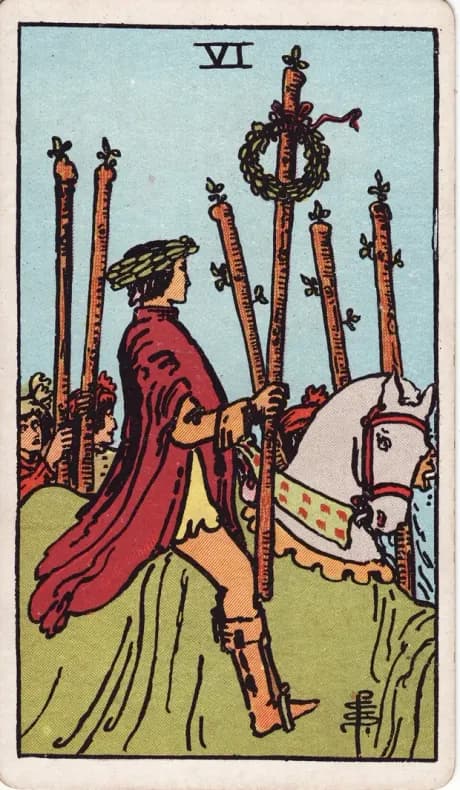
The 1909 card shows a rider on a white horse moving at a walk, wearing a laurel wreath, with a second wreath tied near the top of the staff he carries. People walk beside him on foot, each holding a staff of their own. With his, there are six in the frame.
The doubling of the wreath is the first thing to notice. One sits on his head and one on his wand, which is a small piece of precision: the honour belongs to the man and to the thing he did with it, and the artwork keeps them separate.
The horse is white and draped in a green cloth. White is the colour this deck reserves for horses carrying something significant, and green is the growth colour that runs through the whole Wands suit. This is not a war horse. It moves at walking pace, in step with the people around it, and the reins are held loosely in one hand. Nothing about the speed suggests escape or urgency. The event already happened. This is the part afterwards.
The crowd is the strangest part of the picture. You see the tops of heads and the shafts of their staves and almost no faces. They are drawn as a mass rather than as individuals. A crowd without faces is a crowd that can change its mind, and the card does not pretend otherwise.
Look at the height difference last. The rider's head is above every other head in the frame, and he is the only one not walking. Both things are true at once, and both are the card. Elevation gets you seen. It also means you cannot make out much of what is being said at ground level, and everybody who is carrying this moment is carrying it on foot.
Frequently asked
Is the Six of Wands a yes in love?
+
Yes, and one of the stronger ones. The pursuit succeeds and the effort gets rewarded where people can see it. Upright it means a result plus acknowledgement, not just a result. Reversed, expect the outcome without the acknowledgement.
What does the Six of Wands mean as feelings?
+
They are proud of you and of being with you — feeling that wants witnesses. They mention you to other people, they want to be seen together, and they are not managing anyone's opinion about it. The only caution is that part of the pride may be about themselves.
Is the Six of Wands a yes or a no?
+
Upright, a clear yes. The picture shows a result already delivered and publicly agreed, which leaves very little room for wishful reading. Reversed it becomes a qualified no: usually the thing happens but the credit, the timing or the acknowledgement goes wrong.
What should I do when I draw the Six of Wands?
+
Say the thing out loud. Name what you want, put your name on your work, introduce the person by the title you already use privately. Then name whoever helped you get here, in front of other people. This card rewards being explicit and punishes modesty that has become a habit.
Does the Six of Wands mean someone is showing off?
+
Upright, no — the confidence has evidence behind it and the display is earned. Reversed, often yes: the image starts outrunning the substance, or someone needs an audience in order to feel that anything happened. The reversed card is also how a trophy relationship shows up in a reading.