What Three of Wands means in tarot — and in love
The Three of Wands is momentum confirmed: what you started is expanding — the connection deepens, plans leave the harbor, distance begins closing. As feelings, the Three of Wands means anticipation — they see potential in you and are watching it develop with genuine interest.
Jump to FAQAt a glance
- Yes or no
- Yes — reversed flips it
- Element
- Fire
- Upright, in a line
- momentum, a connection expanding its horizon
- Reversed, in a line
- delays, waiting on someone to move
Want a yes or no on your own situation rather than this card? Pull one card and get the verdict with the reason behind it.
Ask your own yes-or-no questionIn the Golden Dawn tradition this card rules 10–20° of Aries. A planet standing at that degree is read through it: Venus in Aries · Moon in Aries · Mars in Aries
Upright in love
The Three of Wands is momentum confirmed: what you started is expanding — the connection deepens, plans leave the harbor, distance begins closing. It often appears for long-distance love or relationships entering a growth phase. If you asked whether it's moving: the ships are visibly on the water. Keep your position; what you sent out is coming back.
The important part of this card is that something has already been sent. That is the whole difference between hope and this. Somebody said the true thing, made the offer, booked the flight, moved the conversation forward — and the current state is not uncertainty about whether to act. It is the wait that follows having acted. Those two states feel identical from the inside and are completely different situations.
In a new connection it usually means the early work is done and the returns are slow. You have been honest, they responded, and now there is a stretch of ordinary days in which nothing dramatic happens. People misread that stretch as cooling. It is not. It is the distance between two lives being crossed at the speed crossing actually takes.
In an established relationship the card marks a growth phase, often a literal one: two cities, a long project, a stretch apart, a plan that pays off later. The relationship is not on hold during it. It is doing exactly the work it needs to do, which happens to be invisible while it happens. The couples who suffer here are the ones treating the interval as a pause rather than as a part.
What the card asks is unglamorous. Hold your position and make it worth returning to. Do not chase the ships. Do not renegotiate the plan every week because the water looks empty today. Keep your own life good enough that the harbor is somewhere anyone would want to arrive — and check, once, that something really did leave. Waiting is only patience when there is cargo out there.
Reversed in love
Reversed, the Three of Wands is the delayed shipment: progress stalling, plans postponed, one person watching a horizon the other stopped sailing toward. Expectation exceeds delivery. Reassess honestly — waiting is only romantic when something is actually en route.
The reversal has two versions, they call for opposite responses, and they look the same from outside. In the first, a real plan met real friction. Timing slipped, money ran out, somebody's circumstances changed. Nothing is broken except the schedule. That version needs patience plus one honest conversation about the new date.
In the second, nothing was ever sent. The plan was described rather than acted on, and the waiting has been one person's alone. This is the harder read, and there is a test for it: name a specific thing the other person has actually done in the last month. Not felt, not said. Done. If you cannot, you are not waiting for a ship. You are watching an empty sea and calling it a horizon.
There is a third possibility and it stings in a useful way. The expansion was aimed at the wrong place. Some plans fail not because anyone lost their nerve but because they were only ever agreed to by both people, never wanted by both people. Reversed, this card is willing to say that aloud.
The move is to reassess without abandoning. Look again at what was promised, by whom, with what date attached. Then decide whether you are extending the deadline or ending the wait. Both are legitimate answers. Drifting is the only option this card refuses.
Three of Wands As feelings
As feelings, the Three of Wands means anticipation — they see potential in you and are watching it develop with genuine interest. Forward-leaning energy: they've invested and expect this to grow.
This is a patient feeling rather than an urgent one, which makes it easy to underestimate from the receiving end.
If you are single and asking about someone new. They see where this could go and they are letting it develop rather than forcing it. The interest is real and the pace is deliberate. Some of that is respect and some of it is self-protection — they have decided you are worth something and are waiting for confirmation before they say so out loud.
If you are in a relationship. They are invested and looking ahead. Their feelings are attached to a version of the two of you that does not exist yet, and they are working toward it. That is warm, and it has a cost: the present can get less attention than the plan. If you feel slightly unseen while being clearly cared for, this card explains it.
If you are asking about an ex. They are watching. Not acting — watching, from a distance they consider safe, with genuine interest in what becomes of you. Something in them expects that this is not finished, and that expectation is doing precisely nothing to bring it back.
If you are asking about someone long-term. Confidence. They think about the coming years without anxiety and assume you are in them. It is one of the calmer feelings in the deck and one of the least demonstrative, which is why the person receiving it so often reads it as complacency.
Across all four the emotion is future-facing and quiet. The Three of Wands does not describe somebody about to make a scene. It describes somebody who has already decided and is waiting for the world to catch up.
Three of Wands For your ex
For an ex, the Three of Wands can mean watching from a distance: monitoring your life, weighing a return voyage. Movement toward you is possible but unhurried. Live your life visibly; harbors that thrive attract ships.
What makes this specific is the direction of the watching. They are not looking back at what happened. They are looking at what your life is becoming, which is a different and slightly harder thing to be on the receiving end of. It means the version of you they are interested in is the current one, not an edited memory.
A return is genuinely possible with this card. It is also unhurried in a way that has nothing to do with how much they care. People treat distance as safety, and the longer the safety holds, the more expensive re-entry starts to look to them. That is why this card can sit over a situation for a very long time without anything happening in it.
The advice is the same as the upright reading and much harder to follow with an ex in the picture: live visibly, and live for reasons that have nothing to do with being watched. If the life is a performance aimed at one audience, they will feel it and so will you. A harbor thriving because it is thriving attracts ships. A harbor built as bait attracts nothing and costs a season.
Set yourself a limit as well. Watching can continue indefinitely, because it never has to survive contact with an actual conversation. If nothing concrete has crossed the water by a date you choose in advance, the waiting has stopped being about them.
What Three of Wands means in general
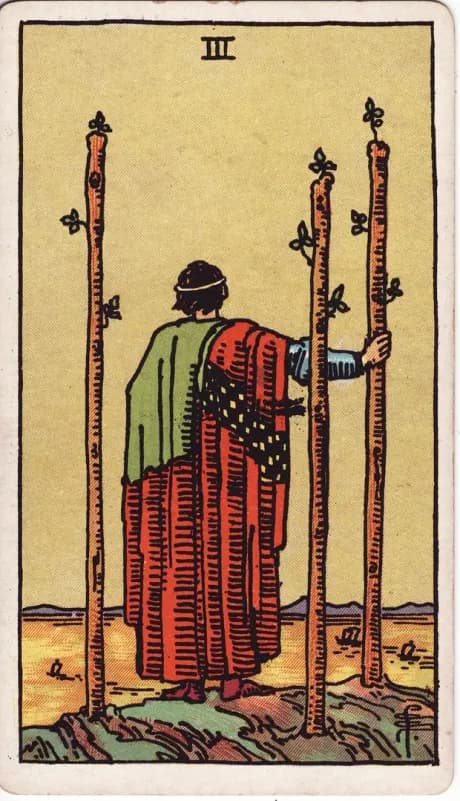
A figure stands on high ground with three staves planted around him, one of them under his hand, watching ships move across the water below. Nothing on this card is being decided. The decision was taken earlier, and the card is what comes after it: the interval between committing and finding out.
Upright it says the venture is sound and under way, that scope is widening, and that the wait is productive rather than idle. It is foresight in the plain sense — the vantage point is high, the view is long, and the thing being watched was set in motion by the person watching it. Results are coming. They are not coming today.
Reversed, the ships do not return on schedule. That covers ordinary delay, an expansion that overreached the resources behind it, and the harsher case where the effort was aimed at the wrong destination and comes back empty. It also catches a specific failure worth naming: watching that has gone on so long nobody remembers nothing was ever dispatched.
At work it is the proposal submitted, the product shipped, the applications out and the inbox quiet. In money it is capital committed with returns pending. In creative life it is the piece released into the world, where the making is over and the reception has not begun.
Twos plan and Fours arrive. The Three is the least comfortable of the three because it has no task attached to it. Everything useful has already been done, and the only remaining skill is the capacity to keep standing on the cliff without trying to haul the ships back by force of will. Most people fail this card not by giving up but by interfering.
Three of Wands as a yes or no
As a yes or no, the Three of Wands upright is a yes with a delay attached. It is one of the more dependable positives in the deck, because it does not rest on a decision nobody has made yet — the thing is already moving. What the card will not do is promise speed. The answer is yes, later, and later is not a hedge here. It is the actual content of the card.
That makes it a poor fit for questions with a deadline inside them. Will he message me this week is the wrong shape for this card. Is this going somewhere is the right shape, and it gets a clear answer.
Reversed it becomes a no for now, and the reason matters. If the plan was launched and has stalled, the no is temporary and the card is describing a schedule rather than an ending. If nothing was ever launched, the no is real, and the honest sentence is that there is nothing in transit to say yes to.
One check is worth doing before accepting the upright yes. Name the thing that has already left: the message that was sent, the money that was spent, the arrangement that was made. If you can name it, the yes is solid. If you cannot, you may be reading your own hope as motion, and this card is precise about the difference between a horizon and an arrival.
Three of Wands as advice
As advice, the Three of Wands says: keep your position and widen your view. You have already done the part that required action. The part in front of you requires something harder, which is declining to interfere with a process you set in motion yourself.
Concretely, that means resisting three temptations. Do not re-send the message. Do not renegotiate the plan because a quiet week made you nervous. Do not shrink the scope to something safer while nobody is looking. Each of those feels like effort, and each of them undoes work that has already been paid for.
What the card does encourage is preparation. If it lands, what happens next? Ships return to harbors, and harbors have to be ready. In plain terms: keep your own life running, keep your standards, keep the friendships and the work and the routine that make you somebody worth arriving to. This is the least mystical advice in the deck and among the most reliable.
Widen the view as well. The figure stands on a cliff for a reason — he can see more than one vessel. If everything you have sent out went to a single destination, that is not patience, it is exposure. Send something else out. Not as a replacement. As a second horizon.
Reversed, the advice changes to verification. Find out what is actually happening. Ask the direct question, check the date, confirm the arrangement. Waiting is a reasonable strategy only when there is something to wait for, and the card reversed exists to make you check that there is.
Three of Wands as an outcome
As an outcome, the Three of Wands is expansion that arrives after the question closes. The situation grows, the direction is right, and the result lands outside the window you asked about. If you wanted a scene — a decision, a conversation, an arrival — this card gives you the approach rather than the docking.
In a question about two people it usually means the connection keeps widening: more contact, more shared plans, more of each other's real lives. Long distance shortens. Something hypothetical acquires dates. None of that is dramatic, and all of it is progress that holds.
The card is also honest about scale. Whatever comes back tends to be larger than what left. This is the outcome you get when a small honest move made months ago turns out to have started something neither person planned in full.
Reversed as an outcome, the return is late or disappointing. Sometimes that is only a scheduling problem and the same result arrives further out. Sometimes what comes back is smaller than what was sent, and the useful question becomes whether the destination was ever the right one. There is a third version people recognise immediately: the outcome where nothing arrives because nothing was ever dispatched, and the waiting itself was the entire event.
What the Three of Wands card shows
The 1909 card shows a figure seen from behind, standing at the edge of high ground with his back fully turned to the viewer. He wears a long red robe under a green mantle, with a band around his head. Three staves are planted in the earth around him, taller than he is, and his right hand rests on one of them.
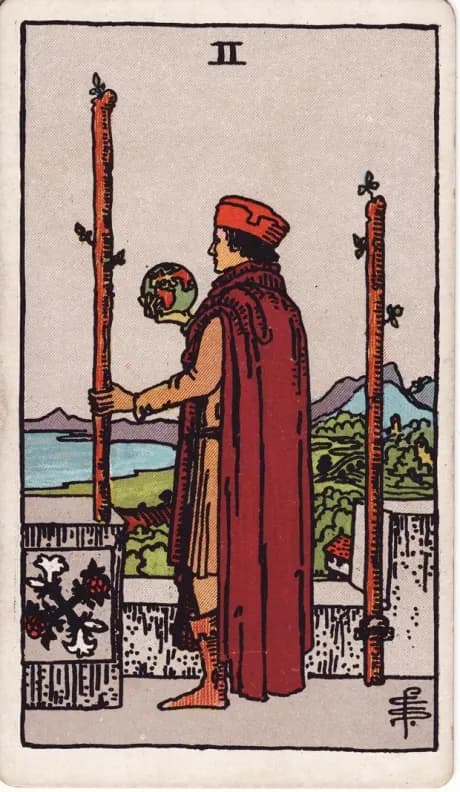
The difference between this card and the Two of Wands is worth looking at directly, because the two pictures are nearly a sequence. In the Two, one staff is bolted to a wall and the man stands on a roof. Here all three stand in the ground, and so does he. He has come down out of the building he owned. That is what commitment looks like in this deck: the same person, the same landscape, no longer standing on top of the thing he had already finished.
Below him the water is golden rather than blue, and ships are crossing it — small, several, and moving. Beyond them a ridge of mountains closes the far side of the bay. The mountains matter. They mark that the ships are going somewhere specific rather than out into open ocean.
His posture is calm and entirely still. Nothing about the figure suggests anxiety, and nothing suggests he intends to move. The staff under his hand is support, not a weapon and not a tool.
And he is turned away. You cannot see his face on this card, and you cannot see it on the Two either. Both cards are about attention pointed outward, at something distant, by somebody who has stopped looking at what is behind him.
Frequently asked
What does the Three of Wands mean for long-distance love?
+
It is one of the card's favourite contexts: patience rewarded, distance shrinking, plans in actual motion rather than in discussion. It suits the situation where the hard part is already agreed and what remains is the crossing. The card asks for steadiness rather than effort.
Is the Three of Wands a yes?
+
Yes — expansion and progress are under way. The timeline asks for patience, and that patience is the card's real instruction. Reversed it turns into a not on schedule, which is a delay when something was genuinely launched and a plain no when nothing ever was.
What should I do when I draw the Three of Wands?
+
Hold your position, prepare for the thing you set in motion to land, and stop pulling at it. Then do one verification: name the concrete step that has already been taken. If you can name it, wait well. If you cannot, you are waiting on an idea rather than on a plan.
Does the Three of Wands mean someone is coming back?
+
It often describes somebody watching from a distance and considering it, which is not the same as somebody travelling toward you. Movement is genuinely possible and it is unhurried. Watch for one concrete, scheduled action rather than for signs of attention.
How long does the Three of Wands take?
+
The deck does not do calendars, and any card that claims to is being read too hard. What this card says about time is structural rather than numerical: longer than you want, and long enough that interfering will feel reasonable. It describes a journey already begun rather than one about to end.