What Nine of Wands means in tarot — and in love
The Nine of Wands is the guarded heart still standing: bruised by the last love, suspicious of the next, yet fundamentally not done. As feelings, the Nine of Wands means cautious investment — they feel something real and defend it behind history-shaped walls.
Jump to FAQAt a glance
- Yes or no
- No — reversed flips it
- Element
- Fire
- Upright, in a line
- guarded but still standing, almost through
- Reversed, in a line
- walls so high nothing gets in
Want a yes or no on your own situation rather than this card? Pull one card and get the verdict with the reason behind it.
Ask your own yes-or-no questionIn the Golden Dawn tradition this card rules 10–20° of Sagittarius. A planet standing at that degree is read through it: Venus in Sagittarius · Moon in Sagittarius · Mars in Sagittarius
Upright in love
The Nine of Wands is the guarded heart still standing: bruised by the last love, suspicious of the next, yet fundamentally not done. It signals resilience — you or they are one honest effort from the finish line, defending against ghosts more than present dangers. If you asked whether to keep trying: yes, but drop one shield. Peeking through armor isn't intimacy.
The state this card describes is not fear. Fear is loud and this is quiet. It is tiredness combined with experience, which produces something more stubborn than either: a person who is still willing, still available, and screening everything through what already happened to them. They have not given up. They have simply stopped assuming things will go well, and the assumption is not coming back on its own.
In a new connection it means somebody is being tested, and the testing is rarely deliberate. Small requests to see how they are handled. Slight withdrawals to see whether anyone follows. A question asked twice in different words. If you are on the receiving end of this, the useful response is boring consistency rather than reassurance, because reassurance is words and this card has stopped trusting words. If you are the one doing it, be aware that a test nobody was told about is a test they can only fail.
In an established relationship it usually means you are near the end of a hard period rather than in the middle of one. The illness, the money problem, the family crisis, the long stretch of not being on the same side. The card says it holds. What it also says is that both of you are running on much less than you think, and that the last part of a difficult year is when people quit, not the first.
What it asks for is specific and small: lower one defence, once, on purpose. Say the thing you have been managing alone. Not all of it. One piece of it, to one person, this week.
Reversed in love
Reversed, the Nine of Wands is armor rusted shut: paranoia rejecting real love as a threat, exhaustion mistaken for wisdom, giving up one step before the breakthrough. The walls no longer protect — they imprison. Someone must risk being unguarded first. It could be you; it might be worth it.
What the reversal changes is the relationship between the guard and the danger. Upright, the vigilance is disproportionate but comprehensible; there was a real injury and it is still healing. Reversed, the vigilance has come loose from its cause entirely and is now running on its own, applied to people who have done nothing and situations that resemble the old one only in shape.
The practical form of this is unfair and worth naming. Somebody kind gets treated as though they were somebody else. A late reply is read as the beginning of the end. An honest apology is examined for the trick in it. None of this is malice, and all of it is exhausting to be on either side of.
The second reversed reading is collapse rather than paranoia. Stopping one step short. Ending something salvageable because you cannot face another round of effort, and calling the decision realism. The tell is timing: if the giving up arrives right after a small setback in a long good stretch, it is fatigue talking, not judgement.
There is a third and quieter version. Sometimes reversed means the guard finally comes down, and what comes with it is everything that was being held back by it. That is not a bad outcome, though it is a loud week.
The instruction either way is to get rest before making decisions. This card has never once produced a good decision made at the end of a long day.
Nine of Wands As feelings
As feelings, the Nine of Wands means cautious investment — they feel something real and defend it behind history-shaped walls. Testing behavior, slow trust. The interest is proven by the guarding itself.
That last point is the one to hold on to. Nobody builds a fence around an empty field, and this card is much more often about how much somebody has at stake than about how little.
If you are single and asking about someone new. They are interested and braced. Expect warmth followed by a step back, then warmth again, in a rhythm that has nothing to do with you and everything to do with the last time. They are watching for the moment it turns, because in their experience it turns. What changes this is time plus consistency, in that order, and nothing else has ever worked. Declarations make it worse, because the last person made declarations too.
If you are in a relationship. They are worn down and still here, which is the whole meaning of this card in one sentence. Something has been hard for a long time: work, family, health, or the two of you. What looks like coldness is usually depletion. The question that gets an honest answer is not what is wrong but what they have been carrying, and it usually turns out they have been carrying it deliberately so you would not have to.
If you are asking about an ex. They are guarded specifically against you, and it is not a performance. Whatever happened left a mark they are still working around, and their caution is a memory rather than a message. They may well still care. Caring and being unwilling to be hurt the same way twice sit together comfortably.
If you are asking about someone long-term. The guarding has outlived its cause. They are defending against a version of you from years ago, or against a threat that resolved and never got announced as resolved.
Nine of Wands For your ex
For an ex, the Nine of Wands means wounds from you two still ache — they're wary, braced, expecting the old pain on approach. Reconnection demands patience and receipts of change. One careless move confirms every fear.
The word that matters there is receipts. This is the card in the deck least moved by an apology, and the reason is structural: they have heard the apology already, or they have heard one exactly like it from somebody else. Words are the currency that was devalued. What has value now is behaviour observed over a period long enough to be inconvenient to fake.
So the pace is not up to you. If they were hurt, the timeline belongs to them, and attempts to accelerate it read as pressure, which is the specific thing this card is braced against. Every message that pushes confirms the model they built of you. Every stretch of consistent, undemanding, unremarkable behaviour weakens it slightly.
There is a version of this reading where the guarded person is you, and it deserves equal weight. If you drew this asking about an ex, you may be the one at the top of the hill with the bandage, deciding whether to let anything back through. That is a legitimate position and does not need justifying to anybody.
The honest caution: this card describes wariness, not desire. It says defended, not interested. Sometimes what is behind the wall is real and waiting, and sometimes the wall is the entire answer and there is nothing behind it but a wish not to go through that again. The only thing that distinguishes them is time, and you do not get to skip it.
What Nine of Wands means in general
A bandaged figure leans on a staff with eight more standing in a row behind him, watching the edge of the frame. The subject is endurance at the point where the reserves have gone: nearly through, visibly damaged, still upright. It also covers the vigilance that follows an injury — attention that was once necessary and has since become automatic.
Upright it says continue, because the remaining distance is shorter than it feels from inside the fatigue. This is the deck's card for the last stretch specifically, and the last stretch is where most things get abandoned. Almost nothing is given up in the first week.
Reversed the defences have become the problem. Suspicion aimed at people who have done nothing. A barricade maintained years after whatever it was built against went away. Or the opposite collapse, in which somebody refuses to admit their capacity is gone and keeps going until something breaks that did not have to.
At work it is month eleven of a twelve-month project, the founder who has survived three near-disasters and now reads every new arrival as a threat, the negotiator who can no longer tell an ordinary request from an attack. In money it is a position held through a bad run by somebody too tired to reassess it. Physically it is straightforwardly the last kilometre of a long distance.
The nines across the deck are near-completion states. Nine of Pentacles has arrived and is enjoying it. Nine of Cups has what it asked for. Nine of Swords cannot sleep. Nine of Wands is the one still on its feet.
The warning is about cost rather than outcome. The watchfulness that carried you this far will start costing you allies once the pressure ends, and nothing ever announces that the pressure has ended.
Nine of Wands as a yes or no
As a yes or no, the Nine of Wands upright is a yes with a bill attached. The thing you asked about does happen, and you arrive at it tired. That is not a hedge. It is the specific content of the card, which shows a figure who is damaged and still standing rather than either victorious or defeated.
The practical translation is: yes, if you last. This card sits one step from completion and consistently reads as the last obstacle rather than a wall. Most of the failures it describes are not defeats, they are people stopping while the answer was still yes, which is why the honest phrasing is closer to yes, unless you quit.
It reads more strongly for questions about persistence than about desire. Will this survive is a question it answers well. Will this be easy is a question it answers with a flat no. Anything asking whether something will resolve without further effort from you gets a no from this card, because effort is the mechanism it describes.
Reversed it turns to no, and the two ways it gets there are worth telling apart. Either the reserves genuinely run out, or the guard becomes the obstacle and refuses the thing it was protecting. The second one is the more common and the more frustrating, because it is a no produced by the person asking rather than by the situation.
If the reversed card appears, the more useful question is not whether this happens but what you need in order to be able to continue, since that is the variable the card is actually pointing at.
Nine of Wands as advice
As advice, the Nine of Wands says: one more round, and get help for it.
The first half is the famous part. The card sits close enough to the finish that its standard instruction is simply to continue, and to distrust the assessment you are currently making, because assessments made at the end of a long effort are reliably worse than the situation. Whatever you are about to give up on, give it one clearly defined further attempt with an end date on it, then decide.
The second half is the part people skip, and it is the one this card actually needs. Tell somebody. A defence maintained alone is what turns into the reversed card, and the fastest way to stop being the man on the hill is to stop being the only one on it. Say one true sentence about what you are carrying, out loud, to a person who can do something about it.
Third, audit the guard. Write down what you are protecting against and then check whether it still exists. Some of the things on that list ended years ago and nobody sent a notification. Removing even one of them returns a surprising amount of energy.
Fourth, and unglamorously: rest before you decide anything. This card has never produced a good decision made at the end of a long day. Sleep, eat, put the thing down for forty-eight hours, then look at it again. If it still looks impossible when you are rested, that is information. If it looks manageable, you were reading fatigue as fact, which is the specific error this card exists to warn about.
Nine of Wands as an outcome
As an outcome, the Nine of Wands means you get through, and you arrive marked. The thing holds. It is not clean, nobody is congratulated, and the ending has more in common with a survival than a victory, but the position is intact and you are still standing in it.
In a question about a connection it usually means the bond outlasts whatever is testing it, with both people more guarded at the end than at the start. That guardedness is the real content of this outcome and the part worth planning for. Surviving something together does not automatically bring people closer. It can just as easily leave two people who trust each other and have both quietly learned to expect less.
In a question about an effort it means the last stretch is genuinely the last one. Not another cycle. The card sits at nine for a reason: what follows completion is a different card entirely.
The useful preparation is for afterwards. Almost nobody plans for the period after a long defence, and it is the period where the damage shows up, because the vigilance does not switch off when the reason for it does.
Reversed as an outcome, the finish is not reached. Sometimes that is exhaustion arriving first, one step short, which is the reading this card is best known for. Sometimes it is the defence itself doing the damage: the thing survives the outside pressure and does not survive the suspicion pointed at it from inside. Look at the cards nearby. Draining company points at the first. Cards about mistrust or isolation point at the second, and the second is the more common of the two.
What the Nine of Wands card shows
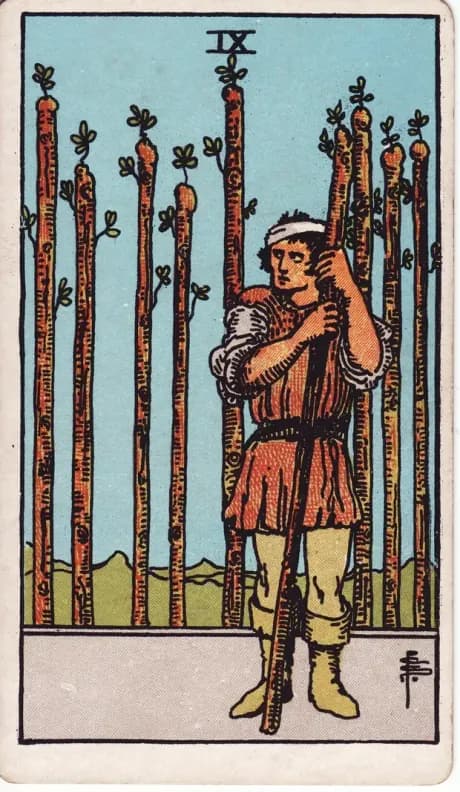
The 1909 card shows a man with a bandage wrapped around his head, standing and leaning on a staff he holds in both hands. Eight more staves stand upright in a line behind him. Beyond them, low hills and a pale sky.
The bandage is the first fact and it settles the meaning of everything else. This is not somebody anticipating trouble. It is somebody who has already had it. Any reading that treats the wariness as irrational is ignoring the head wound, which is drawn plainly and is not something the artwork asks you to infer.
His posture does two things at once. He is leaning, with his weight resting on the staff, which means the staff is holding him up rather than being wielded. And he is looking sideways, past the edge of the card, at something we are not shown. Tired and still watching, in the same figure, in the same second.
The eight staves behind him are the detail most often misread. They are not attacking him. They are his. Everything already achieved stands at his back in a neat row, and he is not looking at any of it, because his whole attention is on what might arrive next. That is the psychology of the card in one composition choice.
The row has gaps. The staves are evenly spaced with clear ground between them, so it functions as a boundary rather than a wall. It marks a line without actually stopping anything, which is an honest picture of what most defences do.
The background is empty. Hills, sky, no army, no attacker, nobody approaching. Whatever he is braced against is not in the frame, and the card refuses to tell you whether it is still coming or left some time ago.
Frequently asked
What does the Nine of Wands mean in love?
+
Guardedness after being hurt — close to the finish of a hard stretch and still braced. It is not indifference. The defending is itself evidence that something is worth defending. What moves it is consistency over time rather than reassurance, because reassurance is words and this card has stopped trusting words.
Is the Nine of Wands a yes?
+
A weary yes: persistence pays if you last one more honest round, and most of the failures this card describes are people stopping while the answer was still yes. Fight the present rather than the past. Reversed it becomes a no, usually through exhaustion or through the guard refusing what it was protecting.
Is the Nine of Wands a yes or a no?
+
Upright, yes with a cost — you get there and you arrive tired. It answers questions about survival and persistence very well and questions about ease with a flat no. Reversed, it is a no, and the more useful follow-up question is what you would need in order to keep going.
What should I do when I draw the Nine of Wands?
+
Give it one more clearly defined attempt with an end date, then decide. Tell one person what you are carrying, because a defence held alone is what becomes the reversed card. Check your list of things you are guarding against for items that ended years ago. And rest before deciding anything.
Why does the man on the Nine of Wands have a bandage?
+
Because the card is about somebody who has already been through the fight, not somebody expecting one. The bandage is the artwork's way of saying the caution is earned. It is the difference between this card and simple paranoia, and it is why the standard advice is patience rather than telling the person to relax.