What Ten of Wands means in tarot — and in love
The Ten of Wands is love as luggage: carrying the relationship alone — planning everything, feeling everything, apologizing for everything. As feelings, the Ten of Wands means overwhelm — they feel the weight of the situation: obligations, timing, emotional load.
Jump to FAQAt a glance
- Yes or no
- No — reversed flips it
- Element
- Fire
- Upright, in a line
- carrying the relationship's weight alone
- Reversed, in a line
- setting the burden down at last
Want a yes or no on your own situation rather than this card? Pull one card and get the verdict with the reason behind it.
Ask your own yes-or-no questionIn the Golden Dawn tradition this card rules 20–30° of Sagittarius. A planet standing at that degree is read through it: Venus in Sagittarius · Moon in Sagittarius · Mars in Sagittarius
Upright in love
The Ten of Wands is love as luggage: carrying the relationship alone — planning everything, feeling everything, apologizing for everything. Devotion mutated into burden. If you asked why it's heavy: because one person is hauling ten sticks and calling it teamwork. The love may be real; the distribution is broken. Set some down and see who picks up.
Nobody picks up ten staves at once. Each one was reasonable on the day it was added. You were better at remembering birthdays, so you remembered them. You noticed the mood in the room first, so you started managing it. You booked the flights because you booked the last ones and it was easier than explaining the system. None of these is a grievance on its own, and that is exactly why the load never gets discussed. There is no single unfair thing to point at, only a total.
In a new connection it shows up as doing all the work of making something exist. You suggest the plans, you keep the thread alive, you smooth the awkward parts. The other person is delighted, and the delight is genuine, which is what makes this hard to name — being appreciated feels close enough to being met. It is not. Enthusiasm received and effort returned are different things, and only one of them tells you what happens in a month when you are tired.
In an established relationship the weight is usually invisible from outside. It is not the chores, it is the knowing: holding the whole list of what everyone needs, when the car is due, which friend is upset, what has to be bought before Thursday. The resentment that builds here is rarely about the tasks. It is about being the only person who knows the list exists, and being thanked for it as though it were a hobby.
What the card asks is unromantic and specific. Set one thing down on purpose, out loud, in daylight. Not a silent strike to see whether they notice, because they will not notice, and then you will have a grievance instead of a change. Name the item, hand it over, and let it be done worse than you would do it. This card never resolves through more effort. It resolves through subtraction.
Reversed in love
Reversed, the Ten of Wands is the drop: finally releasing what wasn't yours to carry — over-responsibility, guilt subscriptions, a one-sided dynamic. Relief follows fast. Sometimes it means delegation learned in time; often it means walking lighter, alone or otherwise. Either way, your back gets its life back.
The reversal does not make the weight imaginary. It changes what happens to it. Upright the load stays on and the walking continues. Reversed it comes off, and the card does not specify whether it came off because you set it down or because you dropped it. Those two produce very different weeks.
The good version is renegotiation. Something is named, handed over, refused or simply stopped, and the sky does not fall. People are frequently astonished by how little collapses when they stop carrying, which is its own uncomfortable piece of information about how necessary the carrying was.
The harder version is release without conversation. Months of unspoken effort come off at once, usually in an argument, usually as a list nobody has heard before. The other person hears an ambush. You feel you are stating the obvious. Both of you are right, and the reason it lands badly is that the reversal is the first time any of it was said out loud.
There is also a reading where reversed means refusing to put it down: martyrdom, scorekeeping, wearing the load as identity because being indispensable is easier than being ordinary. That version has a tell. If you would resent being relieved of the burden, the burden is doing something for you.
Whichever version arrives, the relief that follows is information. If setting one thing down makes the whole situation feel survivable again, the problem was never how much you felt for anyone. It was the arrangement.
Ten of Wands As feelings
As feelings, the Ten of Wands means overwhelm — they feel the weight of the situation: obligations, timing, emotional load. Feelings for you may exist under there, compressed by everything they're hauling. Don't add bricks; don't become one.
Split by situation it reads less like a verdict and more like a report on capacity.
If you are single and asking about someone new. They are interested and they have nothing left over. Work, family, a move, an unfinished chapter of their own — whatever it is, it is taking the part of them that would otherwise be aimed at you. This is not a polite way of saying they do not care. It is a real no about now, and pursuing harder makes you one more item on the pile.
If you are in a relationship. They feel responsible for you more than close to you. Duty reads as warmth for a while and then stops reading as anything at all, and the person carrying it often cannot say what is wrong, because from inside it simply feels like being tired. Ask what they have stopped doing for themselves, not what they feel about you.
If you are asking about an ex. What attaches to your name is tiredness rather than dislike. They remember the effort, and the memory of effort does not soften on its own the way the memory of an argument does. Warmth can still be there. It is under something.
If you are asking about someone long-term. The weight is usually life rather than you: money, work, family, the ordinary accumulation of a decade. The risk after enough years is that a person stops separating the load from the people they are carrying it for.
In every version the card says the same thing. The feeling has not gone. It has been buried under logistics, and logistics are the only part anyone can actually help with.
Ten of Wands For your ex
For an ex, the Ten of Wands means the relationship is remembered as heavy — beautiful maybe, but exhausting. A return only works with a lighter contract: shared weight, honest limits. Otherwise the same load finds the same shoulders.
Memory sorts by cost. Whatever else was true, what stayed with them is what it took, and that is difficult to argue with because it is not an opinion about you. It is the residue of how the days actually went.
There is a tell worth listening for. Notice the words they use when they describe the time you were together. People who miss a person say they miss the person. People carrying this card say it was a lot, or it was intense, or they were not in a good place then. That last phrase is doing quiet work: it locates the weight inside themselves, which sounds generous and also means nothing has changed.
If a return is genuinely on the table, the only thing that makes it different is naming the specific thing that made it heavy. Not an apology for the general shape of it. One concrete arrangement that will be different, agreed before anyone moves anywhere, said in daylight by both people. Without that, the card is blunt: the same load finds the same shoulders, usually within a season, and faster the second time because you both know the route.
What Ten of Wands means in general
Ten staves in one bundle, carried by a single figure who cannot see over them. The subject is not hardship. It is accumulation — obligations taken on one at a time, each of them defensible, each accepted for a good reason, arriving at a total nobody would have agreed to if it had been offered all at once.
Tens are the end of a suit's story, and this is where fire ends up. The Ace was a single branch and pure appetite. Nine cards later the appetite has produced commitments, and the commitments have to be hauled. Success is the mechanism here, not failure. Almost everything on this man's back is something he wanted.
Upright it says the destination is genuinely close and the way to reach it is subtraction. Delegate, refuse, finish, or drop, but stop adding. Reversed the burden comes off — shared out, put down or abandoned — and occasionally the opposite: a refusal to release it, competence curdling into martyrdom, and the collapse that follows carrying alone what was never one person's job.
In work it is the manager who never taught anyone else the system, the freelancer who said yes to everything in a lean year, the volunteer who is now the only one who knows the passwords. In money it is the obligations that arrived attached to good decisions. In creative life it is the maker who now runs the business built around the making and no longer gets to make anything.
The practical question the card asks is short and uncomfortable. If you put this down, what actually happens? Most people carrying ten staves have never checked, and the honest answer is usually smaller than the fear.
Ten of Wands as a yes or no
As a yes or no, the Ten of Wands upright is a no, and it is one of the few cards where the no arrives with a receipt attached. It rarely means the thing cannot happen. It means it will happen at a cost you have not priced, carried mostly by you, and that by the time you get there you will be too flattened to enjoy it. That is a no about the terms rather than a no about the possibility.
Read the picture literally and he is walking toward the destination. He arrives. The question the card raises is not whether but at what price, which is why forcing it into a single syllable throws away the useful half of the answer.
Reversed it is a yes, and a clean one. Something is set down, handed over or refused, and the situation gets lighter. This is one of the reversals that improves a card outright rather than inverting it: the upright is a person under a load, the reversed is the same person without it.
If the card lands upright on a yes-or-no question, the better version of the question is almost always about distribution. Not will this work, but who is doing the work. Not should I keep going, but what would I have to put down in order to keep going. The Ten of Wands answers those two well and the one-syllable version badly, because its entire subject is the difference between something being possible and something being sustainable.
Ten of Wands as advice
As advice, the Ten of Wands says put something down. Not everything, and not eventually. One thing, this week, and one whose absence you will actually feel.
Start by writing the load out. Most people carrying this card cannot name what is on their back, only that it is heavy, and a list is unpleasantly clarifying. Half the items turn out to be small, a few turn out to be enormous, and one or two turn out to belong to somebody else entirely. That last group is the card's target. Over-responsibility is not generosity. It is a habit that quietly tells the other person they are not needed.
Then hand one item over in words, not hints. Say which thing, say you are not doing it any more, and stop talking. Do not design a fair system, do not deliver a summary of everything else you carry, and do not take it back when it is done badly. It will be done badly. Tolerating that is the actual work here, and it is harder than the chore was.
Refuse the two exits the card offers. The first is one more push, on the reasoning that the end is close and you can rest afterwards. The end is always close in this picture and there is no afterwards; another bundle is waiting. The second is the silent test, where you drop everything without telling anyone to see whether they notice. They will not notice. You will have proved something to yourself and lost a month.
Reversed, the advice sharpens to one line: stop now, not at a better moment.
Ten of Wands as an outcome
As an outcome, the Ten of Wands ends with the thing achieved and the person achieving it worn out. The situation completes. That is worth saying plainly, because the card is often read as failure and it is not one. He arrives. What arrives with him is the cost, and the cost is as much the outcome as the arrival is.
Applied to two people, it usually means the arrangement continues exactly as it is. Nobody leaves and nothing is renegotiated. One person keeps doing the organising, the remembering and the emotional maintenance, and gets there. The card is not predicting a rupture. It is describing a state that holds because the person holding it is capable, which is precisely why nobody changes it.
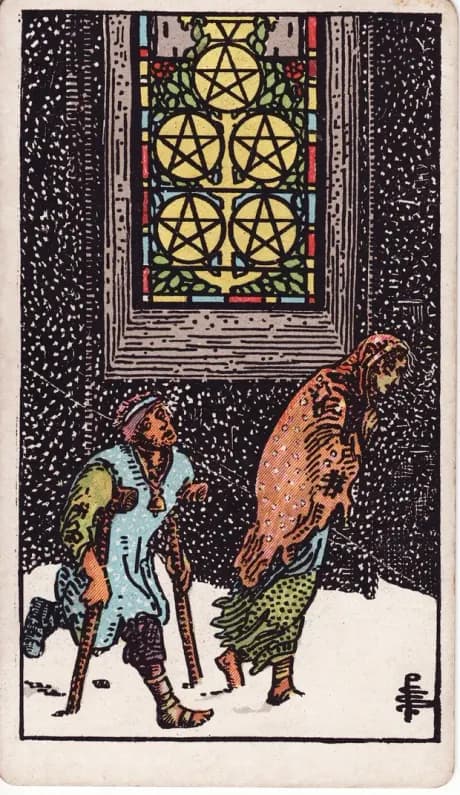
Applied to a project or a decision, it means you finish and immediately inherit the next load. There is no rest anywhere in this card. Look at what sits beside it. The Four of Wands, the Star or the Sun tilts the ending toward relief that actually gets taken. The Nine of Wands, the Five of Pentacles or the Devil tilts it toward a cycle that repeats.
Reversed as an outcome is genuinely better. The weight comes off before the end: work is shared, an obligation is refused, or the whole thing is abandoned and the relief that follows is out of proportion to what was lost. Occasionally the reversal is a collapse rather than a choice, and the load comes off because the person under it stopped being able to hold it. Both endings are lighter. Only one of them was decided.
What the Ten of Wands card shows
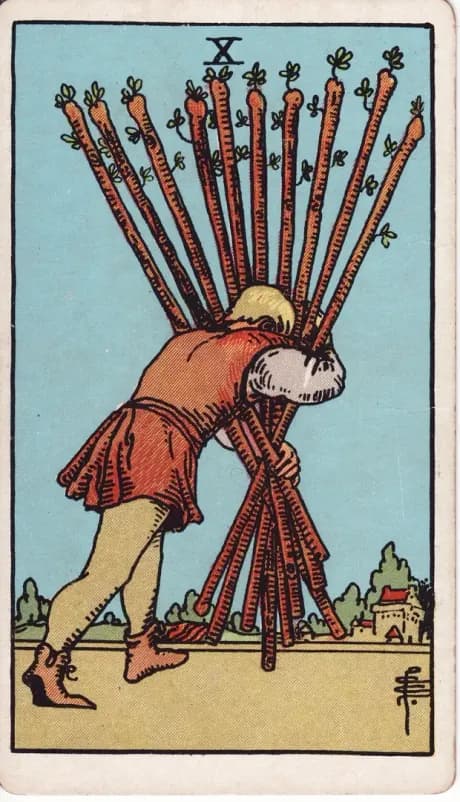
The 1909 card shows a man walking away from us, bent forward under ten staves held in both arms across his chest. The bundle is the first thing to notice and the last thing he can see past: the staves splay upward and outward directly in front of his face, so his view of the ground ahead is gone. He is not lost. He simply cannot see where he is putting his feet.
The staves are in leaf, as they are throughout this suit. That detail matters more here than anywhere else in the deck, because it means the load is alive. These are not rocks or sacks. They are the same growing wands that began as one bright idea in the Ace, and every one of them was picked up on purpose.
Ahead of him, off to the right, sit the roofs of a village. They are close. Anyone looking at the card can see the journey is nearly over, and the man carrying the bundle is the only person in the scene who cannot. This is the picture's cruellest joke and its most practical warning: the load does not only weigh, it blocks the information that would tell you to stop.
The ground is worked earth, brown and turned. Trees stand to one side. The sky is plain and pale with no weather in it at all — no storm to blame, nothing external happening to him.
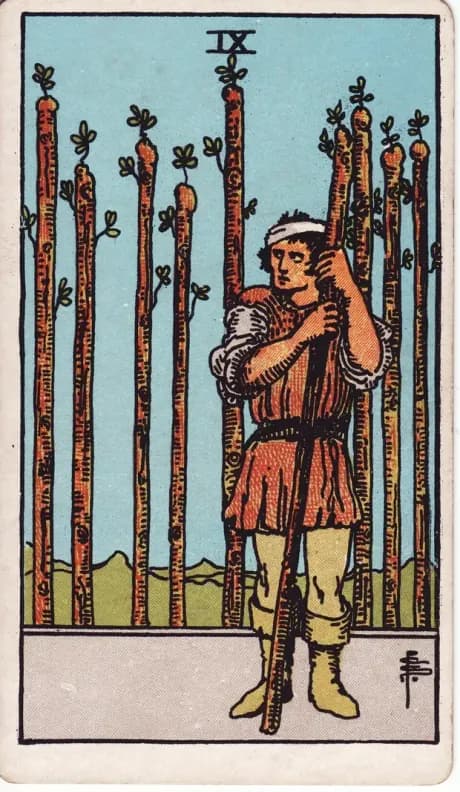
Compare the card immediately before it. In the Nine of Wands a wounded figure stands upright behind a fence of eight staves, watching the horizon. In the Ten he has picked up all of them and started walking, and the wound is no longer visible, because there is no longer anyone facing us.
Frequently asked
What does the Ten of Wands mean in love?
+
One-sided carrying: burnout, over-responsibility, love bent under logistics. The feeling is usually intact and the distribution is not. Redistribute deliberately and out loud, or release. More effort is the one move that never fixes this card.
Does the Ten of Wands mean the relationship is too much work?
+
It means the work is unshared. Love takes effort; it shouldn't take only yours. The test is not how much you are doing but whether the other person knows what the list contains — someone who cannot name the load is not carrying any part of it.
Is the Ten of Wands a yes or a no?
+
Upright it is a no about the terms rather than the possibility: the thing can happen, at a price paid mostly by you. Reversed it is a straightforward yes, because the reversal is the load coming off.
What should I do when I draw the Ten of Wands?
+
Name one thing you are carrying, hand it to somebody else in plain words, and let it be done worse than you would do it. Not a silent test and not a fair overhaul of everything. One item, said out loud, this week.
Does the Ten of Wands mean a breakup?
+
Not by itself. It describes exhaustion, not an ending, and most Ten of Wands situations continue for a long time precisely because the person carrying them is competent. It becomes an ending when nothing is ever set down and the carrying gets mistaken for the relationship itself.