What Page of Wands means in tarot — and in love
The Page of Wands is the flirt with a spark in each pocket: playful messages, spontaneous plans, attraction that feels like an adventure invitation. As feelings, the Page of Wands means excited attraction — you're the fun they look forward to, the notification that lifts their day.
Jump to FAQAt a glance
- Yes or no
- Yes — reversed flips it
- Element
- Fire
- Upright, in a line
- flirtation, an exciting message, free spirit energy
- Reversed, in a line
- scattered attention, all spark no follow-through
Want a yes or no on your own situation rather than this card? Pull one card and get the verdict with the reason behind it.
Ask your own yes-or-no questionUpright in love
The Page of Wands is the flirt with a spark in each pocket: playful messages, spontaneous plans, attraction that feels like an adventure invitation. It heralds exciting romantic news or a free-spirited person entering the chat. If you asked about someone's vibe: fun first, labels later — genuinely enthusiastic, genuinely unfinished. Say yes to the adventure; skip the five-year forecast.
Pages are beginnings and messages, and this one arrives with the energy of somebody who has just thought of something. That is the whole flavour. Not depth, not history, not a plan — the specific brightness of a first week, when nothing has been established and everything is still an idea being tried out loud.
In a new connection the card is close to literal. Somebody is interested, the interest is real, and it has not decided what it wants to be. Expect momentum without structure: a message at an odd hour, a plan invented on Wednesday for Thursday, questions that are actually curious rather than a script. Meeting that energy with a demand for definition is the fastest way to kill it. Letting it run for three months without ever asking is the second fastest.
In an established relationship the Page is a restart rather than an arrival. Something new gets introduced: a trip, a shared project, a first in a long list of things that had stopped having firsts. It can also be news, sometimes about somebody else's beginning. The reading to resist is that novelty means dissatisfaction. Fire needs feeding, and a Page turning up in a long relationship usually means the fire is asking to be fed rather than looking for a different fireplace.
What the card asks for is participation without a forecast. Answer the message. Go to the thing. Let a person stay provisional for a while and watch what they do with the space, because a Page tells you who somebody is by what they follow. The mistake here is not trusting too fast. It is treating a beginning as a promise and then being angry with it for behaving like a beginning.
Reversed in love
Reversed, the Page of Wands is all spark, no campfire: flirtation without follow-through, plans that dissolve by Friday, enthusiasm with a short battery. Or restlessness inside a bond — itching for novelty instead of feeding the fire at home. Charm is not a character reference. Watch completion rates.
The reversal does not turn a warm card cold. It removes the container. Upright the energy goes somewhere. Reversed it goes everywhere, which looks identical for about two weeks and then stops looking identical at all.
The common version is the person whose intentions are entirely sincere at the moment of speaking. They mean the trip. They mean the plan. What they cannot do is carry the enthusiasm from Tuesday to Saturday, and the gap between those two days is where the disappointment lives. This is worth being precise about, because it is easy to read as lying and it usually is not. Nothing was faked. It evaporated.
The second version is restlessness inside something that already works. Boredom gets misread as a verdict on the relationship rather than a signal about how it is being lived. A Page reversed here is not evidence that anyone should leave. It is evidence that nothing new has happened in a long time and somebody has noticed.
The third and least comfortable version is about the reader. If this keeps arriving reversed, look at your own completion rate: the conversations started and dropped, the interest that runs hot right up until it would have to become an actual arrangement. The card does not care which side of the pattern you are on.
The response to all three is the same and it is dull. Stop grading intentions and start grading arrivals. Did the thing happen? Reversed, this card produces an enormous quantity of evidence about feelings and almost none about follow-through.
Page of Wands As feelings
As feelings, the Page of Wands means excited attraction — you're the fun they look forward to, the notification that lifts their day. It's real interest in its playful, uncommitted form. Growth is possible; patience with wobble required.
If you are single and asking about someone new. They are drawn to you and slightly nervous about it, which comes out as jokes, teasing and plans. The feeling is genuine and shallow in the useful sense: it has not been tested by anything yet. They are not weighing a future. They are enjoying the present and hoping it keeps going.
If you are in a relationship. They still find you exciting, which is not a small thing to have kept hold of. The Page here is admiration with heat in it rather than comfort, and it often turns up when one person has recently done something the other found impressive. Being fancied by someone who has already seen your ordinary days is the specific compliment this card is paying.
If you are asking about an ex. They think of you warmly and lightly, without the weight the ending had. Expect curiosity rather than longing: an urge to check on you, a joke they nearly sent, a story watched twice. It is real affection and it is not a plan, and reading it as the opening move of a return usually costs more than it pays.
If you are asking about someone long-term. Restlessness, aimed at the shape of life rather than at you. They want something to happen. The most useful thing you can do with that is give it somewhere to go before it finds its own direction.
Across all four the Page says the feeling is real, current and untested. It tells you nothing whatsoever about duration, and pressing it for that answer produces a promise instead of information.
Page of Wands For your ex
For an ex, the Page of Wands means playful re-approach: the joking message, the meme, the 'remember when' designed to test warmth. Curiosity and spark persist. Whether it's a doorway or just fireworks depends on what they do after you smile.
The approach is deliberately deniable, and that is the design rather than a flaw in it. A joke can be withdrawn. A meme costs nothing. What is being tested is your temperature, and the sender wants to know it before risking anything that could not be laughed off afterwards.
That is not cowardice, but it is information. Somebody sending a Page of Wands message is not yet willing to be turned down in plain language, which tells you exactly where they are: interested, curious and nowhere near a decision.
The thing to watch is the step after your first reply. Warmth returned, and then what? A Page that means something turns into a specific suggestion within a few exchanges. A Page that means nothing stays at exactly this temperature for months, re-lighting whenever they are bored, and it can do that indefinitely because maintaining it costs them nothing.
If you want a real answer, be warm and be concrete. Reply, then name an actual thing at an actual time. This card is honest under the pressure of specifics: it either follows you into the plan or it goes quiet, and either result is worth more than another round of remembering.
What Page of Wands means in general
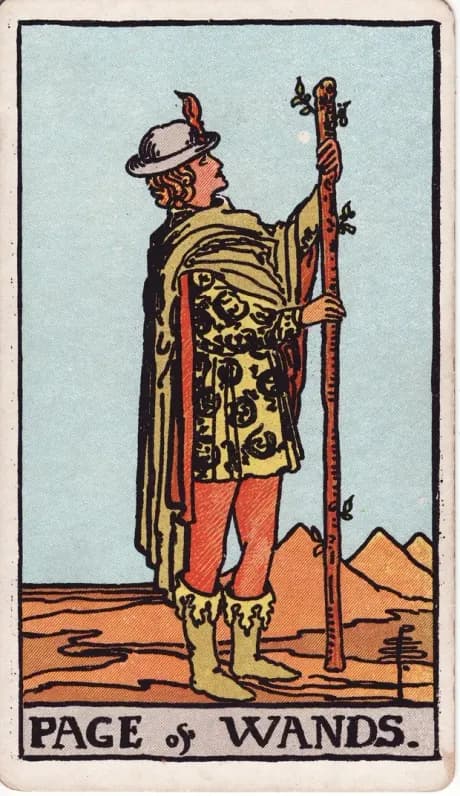
A young figure in a desert holds a sprouting staff and looks up at it, absorbed. The subject is enthusiasm at the start of something, before difficulty has been discovered. Pages are the students of their suits and also the messengers, so this card is both a person and an event: someone curious and unproven, or news arriving with energy attached to it.
Upright it says explore rather than commit. Try the thing badly. The Page has no track record and treats that as freedom instead of a handicap, which is exactly the advantage a beginner holds and loses within a year. In practice it marks the exploratory phase of anything: a trial run, a side project, a conversation had purely to find out what is possible, an announcement that changes the temperature of a room.
Reversed the enthusiasm has nowhere to live. A project abandoned at the first real obstacle, bravado standing in for preparation, a habit of collecting beginnings and never reaching the middle of any of them. It can also be delayed or unwelcome news, or a message that turns out to be noise.
In work this is the junior with better instincts than experience, the pitch made before the research, the prototype built over a weekend that ends up deciding the direction of a year. In money it is a small speculative move, cheap enough that being wrong is affordable. In creative life it is the sketchbook stage, when nothing has become expensive yet.
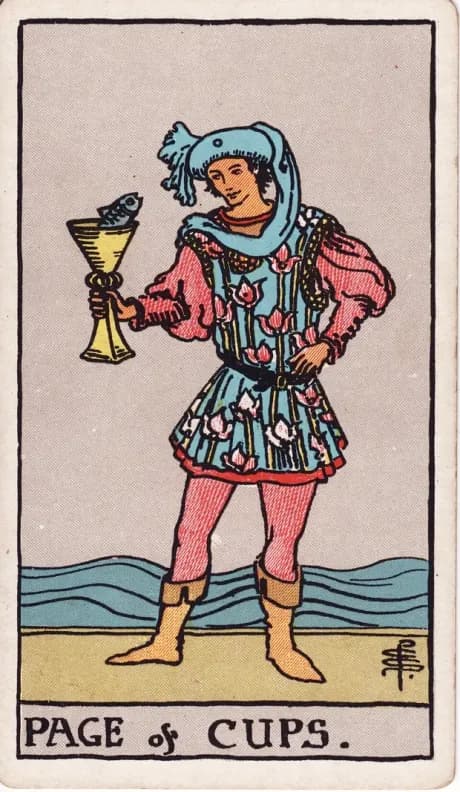
Compare the four Pages. Cups brings a feeling and an offer, Pentacles brings study and patience, Swords brings sharp questions and watchfulness. Wands brings appetite. It knows the least and moves first.
Page of Wands as a yes or no
As a yes or no, the Page of Wands upright is a yes with a qualifier attached. Yes to the beginning, yes to going, yes to the message, yes to trying. It is not a yes to the finished version of the thing, because the card stands at a point where the finished version does not exist and nobody in the picture is pretending otherwise.
That distinction matters most when the question was secretly about permanence. Will this last is a question the Page cannot answer, and any yes it appears to give there is your own hope reading a bright card. Will this start, will they reply, will it be worth doing — those get a clear affirmative.
Reversed it is a no, and a specific one. The intention exists and the follow-through does not. Plans dissolve, interest wanders, the thing gets started and then quietly stops being mentioned. This is not usually a no about anyone's feelings. It is a no about whether something will actually arrive, which for a yes-or-no question is the only part that counts.
If the card seems to resist your question, narrow the timeframe. The Page is accurate about the next two weeks and useless about the next two years. Ask what happens next rather than what happens in the end, and it becomes one of the more reliable cards in the deck.
Page of Wands as advice
As advice, the Page of Wands says go and find out. Not decide, not commit, not build the case first. Take the small version of the thing and do it this week while the interest is still warm, because this energy has a shelf life and it does not come back on request.
Concretely: send the message. Book the one-day version of the trip. Sign up for the class rather than researching the class. Say the interested thing out loud instead of arranging for it to be inferred. The Page's advantage is that he is allowed to be bad at things, and the fastest way to lose that advantage is to wait until you would be good.
There is a second instruction underneath, and it is to follow what actually pulls you rather than what you have decided should. The Page is looking up at his own staff, not out at anybody else. If you notice you keep circling one subject, one person, one idea, the circling is the answer and no further analysis is going to improve it.
What the card does not advise is a decision. Do not turn a spark into a plan on day one, do not ask a new thing to prove it will last, and do not announce it so widely that abandoning it becomes embarrassing.
Reversed, the advice inverts into something duller and more useful: finish one. Pick a beginning you already have and take it one step further than you usually do.
Page of Wands as an outcome
As an outcome, the Page of Wands is a beginning rather than a conclusion. The situation ends at a start: something opens, news arrives, an invitation is made, and the story is clearly going to continue past the edge of the question you asked. That is a genuine result, and a frustrating one if you wanted closure.
In a question about two people it usually means contact resumes or increases, with energy and without definition. Messages, plans, a lightness that was not there before. What it does not deliver is a settled state, so if the question was whether this becomes serious, the honest answer is that the card ends before that gets decided.
For a project or a decision it means the thing gets going and the interesting part happens after the reading. Look at the company it keeps. Grounded neighbours such as the Three of Wands, the Eight of Pentacles or any King suggest the beginning is picked up and built on. Company like the Seven of Cups, the Four of Cups or a reversed Knight suggests it stays a beginning.
Reversed as an outcome is the fizzle. Enthusiasm arrives, nothing is built from it, and within six weeks it is hard to remember why it felt significant. Occasionally it is delayed or unwelcome news instead. Neither version is a disaster, which is the mild consolation this card offers: not much was risked, because not much had been committed.
What the Page of Wands card shows
The 1909 card shows a young man standing alone in a bare, sandy landscape, holding a tall staff planted on the ground in front of him with both hands. He is looking up at the top of it. That is the entire action of the card, and it is worth sitting with: he is not looking at the horizon, at us, or at anywhere he might be going. His whole attention is on the thing he is holding.
The staff is in leaf, as every wand in this suit is. It is alive and still sprouting, which is the picture's way of saying the idea is unfinished. So is he.
His tunic is patterned with salamanders, the creature medieval writers believed lived inside fire and could not be burned by it. Look closely and the salamanders are not identical. Some have their tails in their mouths, forming closed circles, and some do not. The open ones are the point: potential that has not yet come round to itself.
A long red feather rises from his cap, matching the plume the Knight and the King of this suit both wear. It marks him as the same family of energy at an earlier stage.
Behind him, three pyramids stand at a distance under a plain yellow sky. They are far off, monumental and entirely unexplained, and they do the same work in the Knight's card: something enormous exists out there, and he has not gone to it yet.
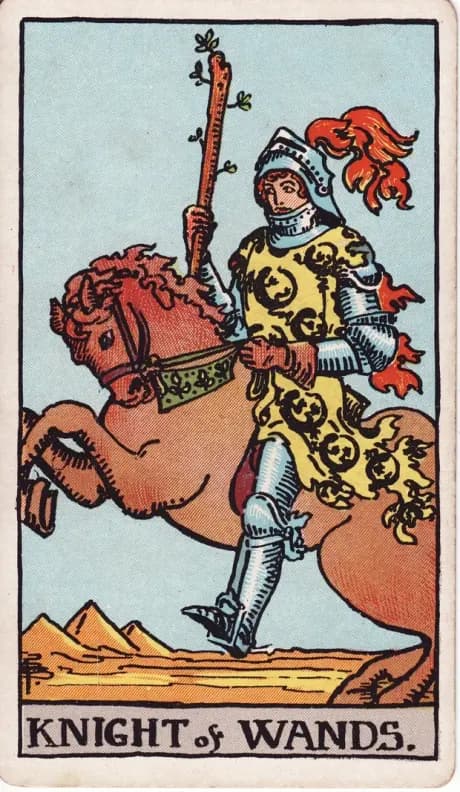
Nothing in the scene is moving. All of the motion in the Page of Wands is intention, which is the honest difference between him and the Knight, who is already at a gallop and has looked at rather less.
Frequently asked
What does the Page of Wands mean as feelings?
+
Playful excitement — flirtatious, adventurous interest that hasn't decided its own depth yet. It is real and it is current, and it tells you nothing about duration. Somebody enjoying you now, without a plan for you.
Is the Page of Wands a yes?
+
Yes for fun, sparks, messages and starting things. Pending for commitment, because the card stands at a point where commitment does not exist yet. Reversed it turns to no: the intention is there and the follow-through is not.
Does the Page of Wands mean someone is going to message me?
+
Often, yes — it is one of the deck's clearest news-and-contact cards, and the contact tends to be light and playful rather than serious. What it does not tell you is what the message will lead to. Judge that by what happens after your reply, not by the message itself.
What should I do when I draw the Page of Wands?
+
Act on the interest this week, in its smallest available form. Send it, book it, try it badly. The card is not asking for a decision or a plan — it is asking you to convert curiosity into one real experience before the enthusiasm cools.
Is the Page of Wands a person or a message?
+
It can be either, and the surrounding cards usually decide. As a person: young in this context rather than necessarily young in years, enthusiastic, exploratory, unproven. As an event: news, an invitation, a spark of contact. When neither fits, read it as your own beginner energy about something you have just started wanting.