What Page of Swords means in tarot — and in love
The Page of Swords is curiosity with your name on it: someone watching your stories, asking your friends, gathering intelligence before making a move. As feelings, the Page of Swords means intrigued analysis — they think about you, watch you, formulate opinions.
Jump to FAQAt a glance
- Yes or no
- No — reversed flips it
- Element
- Air
- Upright, in a line
- curiosity, watching their words closely
- Reversed, in a line
- gossip, surveillance, sharp words flung
Want a yes or no on your own situation rather than this card? Pull one card and get the verdict with the reason behind it.
Ask your own yes-or-no questionUpright in love
The Page of Swords is curiosity with your name on it: someone watching your stories, asking your friends, gathering intelligence before making a move. Communication energy — texts probing for signals, wit as flirtation. If you asked "are they interested?" — they're researching you, which is its own answer. Expect questions; give honest data.
The distinctive thing about this Page is that the interest is real and entirely unadmitted. Not hidden out of strategy — unadmitted because it has not yet been settled internally. They are still deciding what they think, and the researching is how they decide.
In a new connection this looks like a lot of conversation and very little declaration. Questions, jokes, tests disguised as banter, a message that arrives at an odd hour about nothing in particular. It can be read as game-playing and usually is not; it is a person collecting evidence because they do not trust their own first impression.
In an established relationship the Page more often marks a phase of questions than a person. Something has become uncertain and is being examined — sometimes usefully, sometimes as a way of avoiding a conversation by researching around it.
What works with this card is directness, which is exactly what the Page is not supplying. Answering the questions honestly, including the awkward one, tends to collapse the reconnaissance phase quickly. What does not work is matching their indirectness, because two people gathering intelligence on each other can sustain that indefinitely and neither will move.
Reversed in love
Reversed, the Page of Swords is surveillance gone sour: stalking exes online, gossip, sharp messages sent at weak moments, words used to poke rather than connect. Curiosity without kindness cuts. If the communication only ever tests and never trusts — that's the entire message.
The most common reversed reading is watching without contact. Profiles checked, stories viewed at two in the morning, a full picture assembled of someone's life without a single word exchanged. This can be them doing it to you or you doing it to them, and the card is notably even-handed about which.
The second reading is words as small weapons. Not arguments — jabs. The comment that is technically a joke, the question that is technically curiosity, the observation designed to land somewhere tender while remaining deniable. This is the Page's sharpness with the youth removed and none of the honesty added.
There is a third and gentler version: nervousness. Reversed, the card sometimes just describes someone whose communication is erratic because they are anxious, sending three messages and then none for four days. That is not malice, and reading malice into it is a common error.
The instruction across all three is to stop gathering and either say something or stop. Information collected about a person you are not talking to has no use except to feed the loop that collects it.
Page of Swords As feelings
As feelings, the Page of Swords means intrigued analysis — they think about you, watch you, formulate opinions. Mental interest that hasn't declared itself emotionally. You're a fascinating open question they keep re-reading.
If you are single and asking about someone new. You are on their mind and they have not decided what to do about it. The thinking is genuinely favourable — this card describes interest, not scepticism — but it is happening in their head rather than in the world, and it can stay there for a long time without an external nudge.
If you are in a relationship. They are noticing things. Sometimes that is closeness and sometimes it is a quiet assessment they have not shared. Either way it is a card of attention rather than distance; a partner who has stopped caring stops noticing first.
If you are asking about an ex. Monitoring. They know what you have been up to and have not said so. This is the card of the viewed story and the deleted draft, and it means you occupy real space in their thoughts without any of that becoming a decision.
If you are asking about someone long-term. Usually a question they are turning over rather than a doubt. The Page is curious, not disillusioned.
Across all four, the feeling is interest in the head rather than the chest — real, active, and currently unwilling to be the first to say anything.
Page of Swords For your ex
For an ex, the Page of Swords means monitoring: profile checks, mutual-friend inquiries, messages drafted and deleted. Interest expressed as reconnaissance. If contact comes, it starts light and testing. Answer honestly; skip the games they're braced for.
The shape of the eventual contact is predictable enough to describe. It arrives casual, low-stakes, and deniable — a reaction to a story, a message about something objectively trivial, a question with an obvious answer. The lightness is not indifference. It is an attempt to open a channel without risking anything, so that a non-response costs nothing.
How you handle that first contact usually determines the whole sequence. Matching the deniability keeps everyone safe and stationary. Answering it plainly and warmly, without pretending it is more than it is and without punishing them for the smallness of it, tends to move things faster than any strategy.
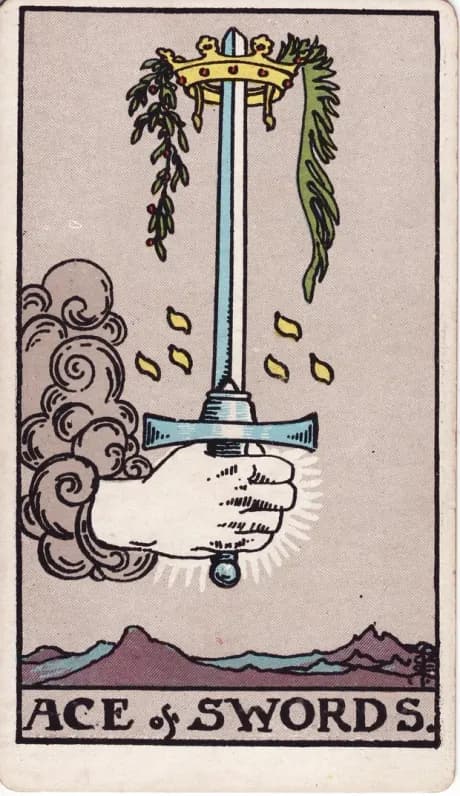
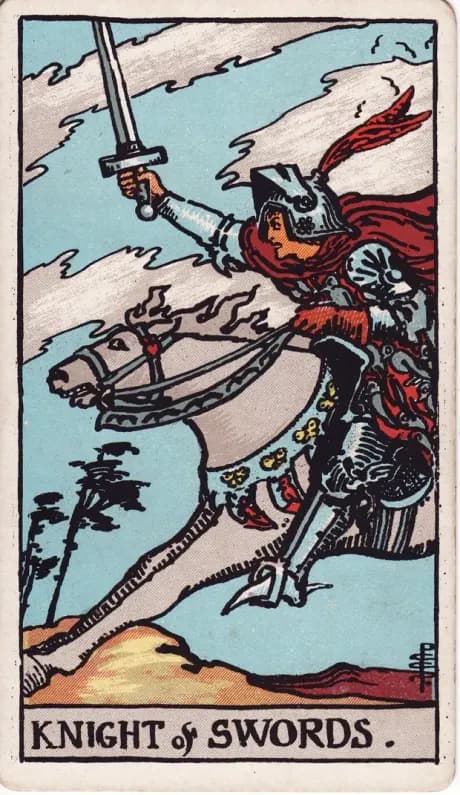
What this card does not indicate is a plan. The Page gathers; he does not usually act. If you want a read on whether anything will happen, look at what else is on the table — a Knight or an Ace nearby suggests the reconnaissance turns into a move, and their absence suggests it does not.
What Page of Swords means in general
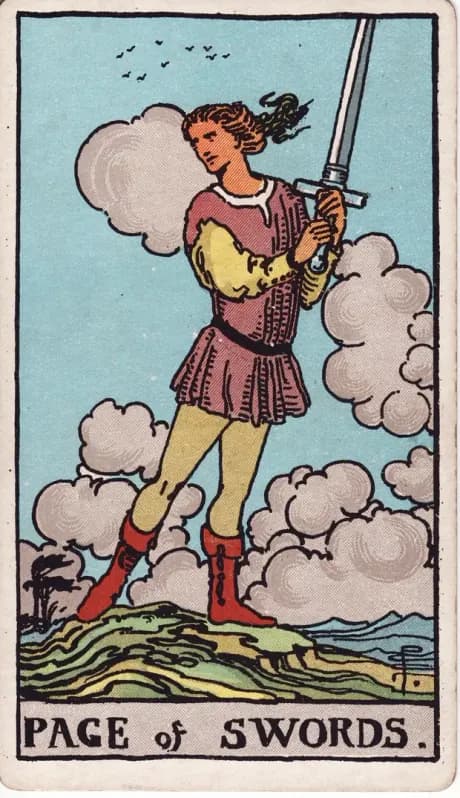
The Page of Swords stands in a windy field holding a blade upright, watching in every direction. His subject is curiosity with an edge — questions asked, information gathered, a sharp mind that has not yet learned what to do with itself.
Upright he is the beginner in the suit of thinking. That means alertness, quick learning, ideas that arrive faster than judgement, and a willingness to say the obvious thing that everyone else was avoiding. He is the card of the person who asks the question in the meeting.
Reversed the sharpness turns unproductive. Gossip, suspicion, information gathered for its own sake, talking about a thing rather than doing it. Or simple nervous scatter — a mind moving quickly in no direction.
Outside the personal, the card is consistent. In work it is research, due diligence, the junior who spots the flaw. In study it is the good phase, where everything is interesting and nothing is settled. In writing it is the notes stage. In business it is the competitor watching you closely.
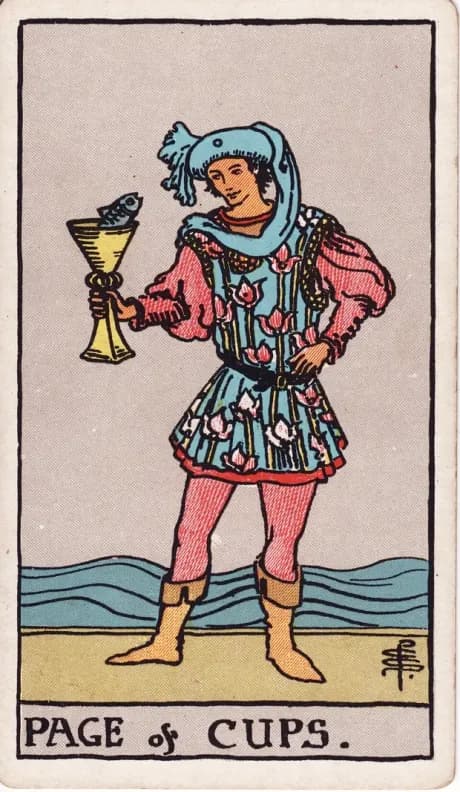
Among the Pages, each learns through a different faculty: Cups through feeling, Wands through doing, Pentacles through practice. Swords learns by asking, and by testing what he is told against what he observes.
The card carries one consistent caution across every context. Gathering is not deciding. This figure can stay in the field indefinitely, alert, well-informed and entirely stationary, and the suit gives him no natural moment at which watching turns into acting.
Page of Swords as a yes or no
As a yes or no, the Page of Swords upright is a qualified yes — the interest is real, the situation is live, and something is developing. What it does not promise is arrival. This is the yes of a process that has started rather than a result that is coming.
In practice that makes it a poor card for questions with a deadline. If you asked whether someone likes you, the answer is yes. If you asked whether they will do something about it, the card genuinely does not know, and the honest reading is to say so rather than to convert curiosity into commitment on the querent's behalf.
Reversed it turns to no, and the flavour is talk without substance. Something is being discussed, examined, or watched instead of done. Reversed, this card also frequently signals that the information you are working from is incomplete or second-hand, which is its own answer to a question about whether to proceed: not yet, and not on this evidence.
For timing, the Page is one of the quicker courts in a suit that generally moves at the speed of thought. Days rather than months. But its speed is the speed of noticing, not of acting, and those are easy to confuse when reading it.
Page of Swords as advice
As advice, the Page of Swords says: ask. Directly, out loud, of the person who has the answer. The card describes a situation where you have been assembling a picture from fragments, and the fragments are never going to resolve into certainty no matter how many you collect.
Concretely that means the awkward question. Not a probe, not a hint dropped to see what comes back — the actual sentence. The Page's whole weakness is indirectness, and taking his advice means doing the one thing he does not do naturally.
There is a second instruction about honesty in the other direction. This card advises being straightforward about your own position, including the parts you would rather hold back for leverage. Information withheld to maintain an advantage tends to produce a relationship conducted entirely in reconnaissance, and the Page is the card that shows what that costs.
Reversed, the advice sharpens: stop looking. Close the profile, stop asking mutual friends, stop rereading. The reversed Page describes surveillance that has become a substitute for contact, and the only thing that reliably breaks it is refusing to gather any more. What you learn by watching is never the thing you actually want to know, which is what they would say if you asked.
Page of Swords as an outcome
As an outcome, the Page of Swords is a situation that ends in more information rather than in resolution. You find out something. What you do with it is left open, and often the finding-out is genuinely the whole result — a question answered, a suspicion confirmed or dissolved, a fact established.
In love questions this frequently means clarity without commitment. You learn where you stand and nothing changes structurally. That is a real outcome and an unsatisfying one to receive, because most people asking a love question want an event rather than a fact.
It can also mean a conversation happens. The Page is the communicative court, and as an outcome he often delivers the exchange rather than the decision — the talk you have been circling finally takes place, and it clarifies more than it settles.
Reversed as an outcome is worse: the situation ends in rumour, misunderstanding, or a conclusion drawn from bad information. This is the result where somebody acts on a story rather than on facts, and the frustration of it is that the correction usually arrives later and too late to matter. If you get this and can still verify something before deciding, verify it.
What the Page of Swords card shows
The 1909 card shows a young figure standing on rocky, uneven ground, holding a sword upright with both hands. The blade is vertical and held slightly away from the body, in a grip that is neither a guard nor an attack.
Everything in the picture is in motion. The clouds are ragged and windblown, the trees at the edge bend hard in one direction, the figure's hair blows across their face, and the grass lies flat. This is the windiest card in the deck, and wind is the suit's element made visible — air in motion is thought in motion.
The posture is the detail worth studying. The body faces one way and the head is turned sharply the other, looking back over the shoulder. Nothing in the frame is behind them to look at. The figure is watching in a direction they are not going, which is the entire behaviour the card describes.
Ten small birds are scattered across the sky in two groups. In this deck birds accompany the Swords suit as the creatures of air, and here they are numerous and dispersed rather than purposeful — thoughts, plural and unorganised.
The ground is high, uneven and rocky, with the land falling away behind. The figure has climbed somewhere with a view, which is exactly what a person gathering information does.
There is no opponent anywhere in the picture, and no target. The sword is raised against nothing at all.
Frequently asked
What does the Page of Swords mean in love?
+
Someone is curious about you and researching rather than declaring — questions, banter, stories watched. The interest is genuine and unadmitted, usually because they have not settled what they think yet. Directness from you tends to collapse the phase quickly.
Does the Page of Swords mean someone is watching my social media?
+
Very often, yes, especially reversed. It is the card of the viewed story and the drafted-then-deleted message. It means you occupy real space in their thinking without any of that having become a decision.
Is the Page of Swords a yes or a no?
+
A qualified yes: the interest is real and something is developing. It is a poor card for questions with a deadline, because it describes a process starting rather than a result arriving. Reversed it is a no — talk instead of action, or bad information.
What should I do when I draw the Page of Swords?
+
Ask the actual question, out loud, of the person who has the answer. The card's weakness is indirectness, so taking its advice means doing the thing it does not do naturally. Reversed, stop gathering — close the profile and stop rereading.
Why is the figure looking backwards on this card?
+
Because there is nothing behind them to look at. The body faces one way and the head is turned sharply the other, watching a direction they are not going. That mismatch is the behaviour the card describes: alert, well-informed and entirely stationary.