What Ten of Pentacles means in tarot — and in love
The Ten of Pentacles is love that becomes an institution: family, shared homes, joined finances, a bond woven into generations — the relationship your… As feelings, the Ten of Pentacles means legacy-grade intention — they picture you in the family photo, the mortgage, the long story.
Jump to FAQAt a glance
- Yes or no
- Yes — reversed flips it
- Element
- Earth
- Upright, in a line
- long-term security, family, a legacy love
- Reversed, in a line
- instability at the foundation, family friction
Want a yes or no on your own situation rather than this card? Pull one card and get the verdict with the reason behind it.
Ask your own yes-or-no questionIn the Golden Dawn tradition this card rules 20–30° of Virgo. A planet standing at that degree is read through it: Venus in Virgo · Moon in Virgo · Mars in Virgo
Upright in love
The Ten of Pentacles is love that becomes an institution: family, shared homes, joined finances, a bond woven into generations — the relationship your grandkids will reference. It signals long-haul compatibility and material harmony. If you asked about their intentions: this card thinks in decades. Legacy love — slower to ignite, nearly impossible to burn down.
What the card describes is not really a feeling. It is a structure. The Ten is the point where two people who like each other turn into a small institution with an address, a routine, obligations to other people, and a shape that would take genuine effort to take apart. That is its strength and its cost stated in the same sentence.
In a new connection this card is unusual and slightly startling. It says one of you, or both, is already thinking structurally — about where this would live, who it would involve, what it would look like at a family table in four years. That is not the same as fantasy. It is a plan, and with this card it tends to be accurate. The risk at this stage is a different one: building the frame before you know the person, and choosing someone who fits the life you designed rather than designing a life around who they turn out to be.
In an established bond it is the card of the long middle. The mortgage years. The shared calendar. Two families that now have to be in the same room. Nothing here is dramatic and everything here is load-bearing. It is a good sign in this position, with one specific warning attached: an institution can run for years on momentum, and momentum feels exactly like agreement long after agreement quietly lapsed.
What the card asks is that you check what you are actually building and whether both of you still want it. Say the plan out loud. Name the money. Name the arrangements with relatives. Couples under this card almost never fail from a shortage of feeling. They fail from unspoken assumptions that surface for the first time when something expensive happens.
Reversed in love
Reversed, the Ten of Pentacles is the estate in dispute: family opposition to the relationship, money strains cracking the romance, stability performed for appearances while the inside erodes. The structure needs honest repairs, not better staging. Marry the person, not the portfolio — and make the family yours by boundary, not surrender.
The reversal does not delete the structure. It sends the bill for it. Everything the upright card builds — shared property, joined families, a plan that involves other people's expectations — carries a maintenance cost, and reversed is the moment that cost arrives in a form nobody wants to sit down and discuss.
In a new connection the reversal usually points outward rather than inward. The two of you are fine and the surroundings are not. Relatives who disapprove. Two very different assumptions about money that neither of you has said aloud. A background that one set of parents treats as a problem to be managed. This is not the card telling you the connection is wrong. It is telling you the pressure is external, and external pressure has to be handled jointly, because handled separately it divides people by design.
In an established bond the reversal is the house that looks correct from the street. Stability maintained for an audience — relatives, children, mutual friends, an image — while the inside has not been repaired in years. People recognise this reading instantly and dislike it, because the staging almost always started as kindness. Nobody performs a functioning home out of malice. They do it because dismantling the performance is enormous and postponing it costs nothing today.
Repairs, not restaging. Have the specific conversation about the specific number. Decide together which family obligations you keep and which you decline, then hold that as one decision rather than two. The card is not against the institution. It is against paying for one nobody has audited.
Ten of Pentacles As feelings
As feelings, the Ten of Pentacles means legacy-grade intention — they picture you in the family photo, the mortgage, the long story. It's love as commitment infrastructure. When this card speaks, meet-the-parents is already scheduled in their head.
That is heavier than it sounds, and it lands differently depending on where you are asking from, so it is worth taking the four cases separately.
If you are single and asking about someone new. They are evaluating you as a permanent fixture rather than as a season, and they may well have got there faster than you did. The feeling is warm, serious and unusually forward-looking. It also tends to be undemonstrative: this card expresses itself as planning rather than as pursuit, so you may be receiving a considerable amount of intention and almost no obvious flirtation.
If you are in a relationship. They consider the matter settled. You are not a question in their mind and have not been for some time, which is genuinely good news and carries the card's standing risk — settled can quietly become unattended, and nobody notices the difference from the inside.
If you are asking about an ex. What they feel is the loss of a future with an address attached. Not a longing for a night, a longing for a plan. That is why this particular grief lasts so long and produces so few messages.
If you are asking about someone long-term. The feeling has been built into things: the house, the accounts, the way the week is arranged. Ask them to describe it and you will get a list of arrangements. That is not evasion. For this card, the arrangements are the description.
Across all four the Ten of Pentacles says one thing in four registers. The feeling has been made into a structure. That makes it durable, slow, and very easy to stop hearing, because the structure has been saying it for years instead of them.
Ten of Pentacles For your ex
For an ex, the Ten of Pentacles means what's mourned is the future you two had drafted — the home, the family, the plan. That blueprint still exists in them. Reunions here are serious proposals or nothing; nobody redraws an estate for a fling.
It is worth naming precisely what is being missed, because it changes what you should expect. This is not somebody aching for your company at two in the morning. It is the loss of a plan — the house, the timeline, the version of forty they had already imagined with you in it. Plans are heavy things, and grief for a plan outlasts grief for a person by a considerable margin.
That has two consequences. The first is that they are unlikely to reach out impulsively. People under this card do not send messages they regret; they build a case, and the case takes months. When contact comes it arrives with a proposal attached. The second consequence is harder to hear: it is entirely possible to be genuinely missed as the co-author of a future and not especially missed as yourself.
So the test is whether what they want back is the plan or the person. Ask what they picture. If the answer is a structure — the home, the timeline, the arrangement with families — and you are the figure standing in it, you have learned something useful. If the answer starts with something specific about you that has nothing to do with any of that, it is worth taking seriously. Nobody redraws an estate for a fling. People do sometimes mistake the estate for the reason they wanted it.
What Ten of Pentacles means in general
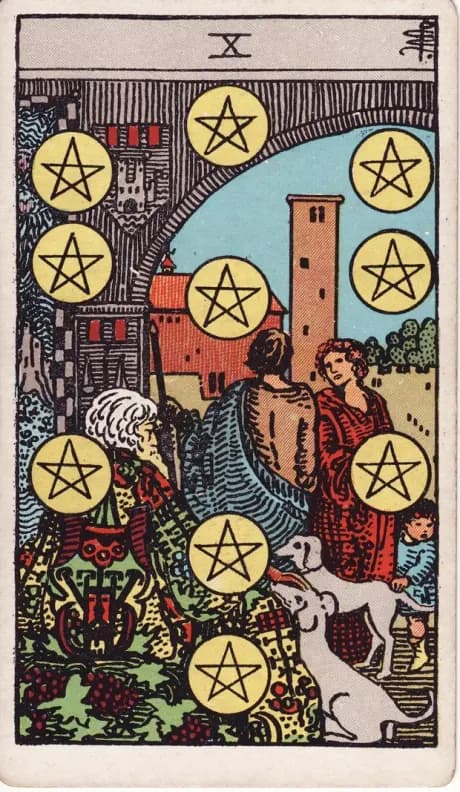
Three generations under a stone arch, two dogs, a gate that belongs to the household standing in it: the suit completed, and the deck's picture of inheritance. Ten coins hang over the scene in the pattern of the Tree of Life, and the subject is wealth that has outlived whoever earned it.
Upright the card says the situation is stable at a structural level rather than a personal one, and that decisions taken now will still be in force in ten years. This is success in its settled form: dull, secure, administered by more than one person. It also carries the deck's clearest statement about time. Some things only make sense on a scale longer than a single life, and this is the card where those things get counted.
Reversed the inheritance is contested. Relatives fighting over an estate. A foundation that proves shallower than advertised. Stability that everyone maintains and nobody chose. Reversed can also mean an institution that has outlived its purpose and is being kept breathing out of duty, which is expensive in ways that never appear on a statement.
In work it is the established firm rather than the new venture — succession, pensions, the handover document nobody wants to write. In money it is the will, the deed, the boring instrument that compounds quietly while its owner is asleep. In creative life it is the body of work rather than the piece: the archive, the catalogue, the thing a student finds in forty years and takes seriously. Tens finish their suit, and what this one finishes is the long argument of Pentacles — that patience applied to material things eventually stops being about you at all.
Its characteristic blind spot is drawn directly into the picture. The elder who built every bit of this sits at the edge of his own scene, and not one member of the household is looking at him.
Ten of Pentacles as a yes or no
As a yes or no, the Ten of Pentacles upright is a strong yes and an unusually durable one. It answers well on questions about permanence: will this last, is this secure, is it worth committing to, will the arrangement hold. On all of those the card is affirmative and steady.
It answers badly on questions about speed. The reason is written into the card itself, which describes arrangements that took years to assemble and will take years to change. A yes here is a yes about the shape of a thing, not about next month. If your question secretly contained a deadline, the card is agreeing with the words while quietly disagreeing with the timeframe.
Reversed it is a no of a specific kind. Not "this will fail" but "the foundation is not what you were told". Money disagreements, family opposition, a structure that looks solid and has never been inspected. The honest reversed phrasing is: not on these terms, and not until the thing everybody is stepping around gets said out loud.
It is one of the better cards to receive on a yes-or-no question, because it comes with a checkable condition attached rather than a mood. Ask the follow-up: what is this actually built on. Upright, the answer will be something real — shared history, a written agreement, an asset, a family that functions. Reversed, the answer will be an assumption nobody has verified. Either way the card is more useful as a question than as a verdict.
Ten of Pentacles as advice
As advice, the Ten of Pentacles says build for a timeframe longer than the one you are currently worried about. Whatever you are deciding, decide it as though the decision has to survive a decade and several other people, because with this card it does.
Concretely: write the thing down. This card is unusually literal about paperwork. Who pays what, what happens if, what belongs to whom, what the arrangement is when circumstances change. The Ten of Pentacles is the deck's argument for boring documents, because a structure held together entirely by goodwill fails at exactly the moment goodwill runs short.
Second: involve the other people now, while the thing is small. There are families here, there are histories, there are people who will be affected and who will eventually have an opinion. Bringing them in early is uncomfortable at a manageable volume. Bringing them in late means the decision is fixed and the objection arrives at full volume.
Third: examine what you inherited. Everybody arrives carrying assumptions about home and money that came from the household they grew up in and have never once been held up to the light. Two people can agree completely and mean entirely different things, and this card is where that discovery usually gets made.
Reversed the advice narrows to one instruction: inspect the foundation before you add another floor. Do not stage, do not extend, do not decorate. Find out what the structure is actually standing on and be prepared for the answer to be less than you were promised.
Ten of Pentacles as an outcome
As an outcome, the Ten of Pentacles is a settled ending. The situation resolves into something permanent, administered, and shared with other people. It is not a moment of triumph. It is a state of affairs.
In a question about two people it usually means the arrangement becomes formal in some visible way: a home, a joined account, a family that treats you as one unit, a status the outside world can see and use. Endings of this kind are quiet and difficult to reverse, which is the entire nature of the card. What arrives is not excitement. It is permanence, and permanence tastes to some people like safety and to others like a door closing.
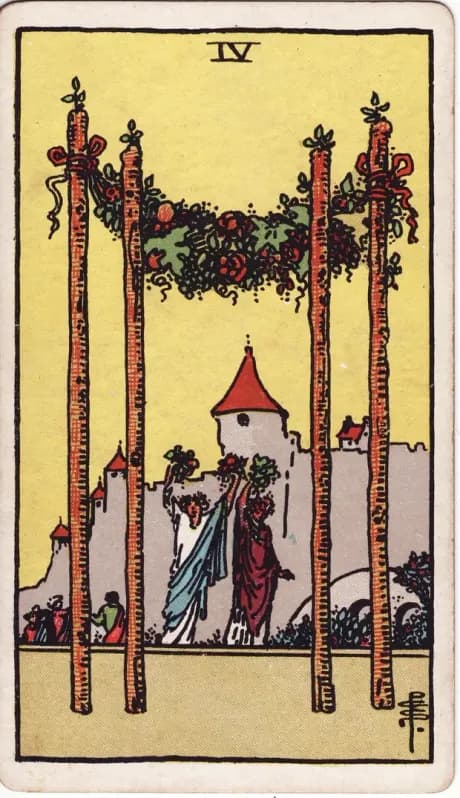
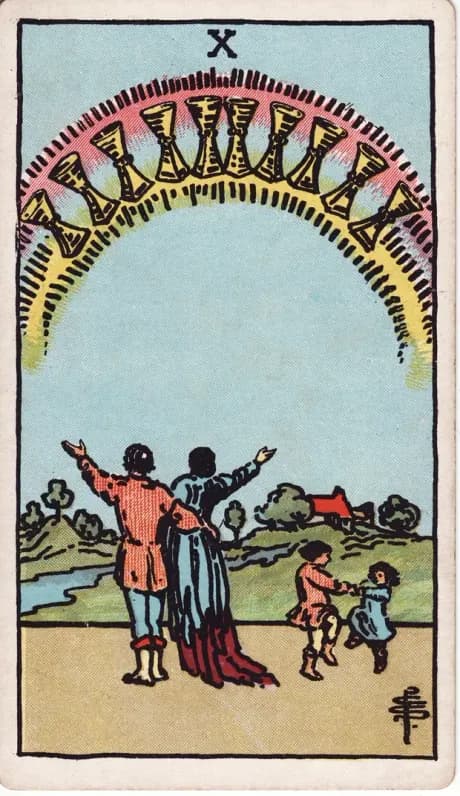
There is a colder version. This card as an outcome can be a structure everyone maintains and nobody enjoys — the house that cannot be sold, the arrangement that continues because unpicking it would be ruinous. The company around it tells you which one you are looking at. Warm neighbours (Ten of Cups, the Sun, Four of Wands) give you the good version. Cold ones (Four of Pentacles, the Devil, Eight of Swords) give you the maintained one.
Reversed as an outcome is a structure that does not hold: an inheritance disputed, a plan that dissolves once the money is examined, a stability that turns out to have been paid for by one person alone. It is rarely sudden. Things built this slowly come apart at the same speed, and the reversal usually describes a long unpicking rather than a break.
What the Ten of Pentacles card shows
The 1909 card is a scene rather than a portrait, and almost everyone reads it too fast. Under a heavy stone archway a young couple stand talking. A child at the woman's side has one hand resting on a white dog. There are two white dogs, and both of them are attending to an old man seated in the foreground at the right — the only figure in the picture who is on his own.
His robe is the most worked garment in the deck: crescent moons and grapevines covering the whole cloth, a record of a long life and a harvest already brought in. He is sitting inside his own gate, at the edge of his own frame. The couple do not look at him. The child does not look at him. The dogs do. That single arrangement is the card. The person who built the estate has already become part of its furniture.
Beyond the arch there is a town, ordinary and busy, and set into the stonework above the passage a coat of arms — the household's claim, made permanent in something that outlasts everybody who lives here. The arch is a threshold, and this is a family standing in a doorway they own.
The ten coins are not part of the scene at all. They float over it in the pattern of the Kabbalistic Tree of Life, the only card in the deck that lays its suit emblem out as a diagram instead of as objects in the world. The wealth is not sitting anywhere in particular. It is the structure everything else hangs on.
Nothing in the picture is happening. Nobody is working, arriving or leaving. It is a card about a moment that took three generations to arrange and will look exactly the same tomorrow.
Frequently asked
What does the Ten of Pentacles mean in love?
+
Long-term security: family, home and lasting commitment, the suit's dynasty ending. It describes a bond that has become a structure — shared money, shared address, both families involved. Strong on permanence, slow on excitement, and it thinks in decades rather than in months.
Is the Ten of Pentacles a marriage card?
+
One of the strongest in the deck. Permanence, family integration and shared wealth all live here. It does not promise a date, and it says nothing about how anybody feels on the day. What it describes is the arrangement: two lives merged at the level of property, relatives and long-term plans.
Is the Ten of Pentacles a yes or a no?
+
Upright it is a firm yes on anything about lasting, holding or being secure, and an unreliable yes on anything about speed. Reversed it is a no with a reason attached — the foundation is not what it was described as, usually money or family opposition, and the answer stays no until that gets said out loud.
What should I do when I draw the Ten of Pentacles?
+
Say the plan out loud and write down the practical parts. This card describes structures that run for years on unexamined assumptions, and the cheapest moment to find a mismatch is now. Name the money, name the arrangements with families, and check that the thing you are building is one you both still want.
Who is the old man in the Ten of Pentacles?
+
He is the one who built the estate, seated at the edge of his own gate while the young family talks past him. Only the dogs and the child notice him. He is usually read as the ancestor, the founder, or simply the earlier generation whose work everyone standing there is living inside without thinking about it.