What The Hierophant means in tarot — and in love
The Hierophant is traditional love: commitment with witnesses, meeting the family, rings and shared values. As feelings, the Hierophant means they see you as long-term material — someone to introduce, to plan around, to keep.
Jump to FAQAt a glance
- Yes or no
- Yes — reversed flips it
- Upright, in a line
- commitment, tradition, a relationship with structure
- Reversed, in a line
- breaking conventions, mismatched values
Want a yes or no on your own situation rather than this card? Pull one card and get the verdict with the reason behind it.
Ask your own yes-or-no questionUpright in love
The Hierophant is traditional love: commitment with witnesses, meeting the family, rings and shared values. It often appears when a relationship is ready to formalize — or when your paths need a shared belief system to survive. If you asked about intentions, this person thinks in long terms and old rules. Courtship, not situationship.
Underneath the formality there is a reason for the formality. A private agreement between two people can be revised any evening either of them feels like revising it. A public one is harder to walk away from, and this card's position is that the difficulty is the feature. Witnesses are not decoration. They are what makes a promise expensive.
In a new connection it describes a slow, deliberate, visible courtship. Introductions to people who matter. Dates that look like dates. A pace that can feel almost old-fashioned, because it is. Nobody here is being kept as an option, and nobody is finding out about the situation from an internet post. If you have spent years in undefined arrangements, this is either a relief or an alarm, and it is worth knowing which before you answer it.
In an established relationship the card points at shared framework rather than shared feeling. What do the two of you actually believe about money, family, obligation, how a household runs, what counts as a betrayal. Couples rarely break over a disagreement. They break over discovering, late, that they were working from two different rulebooks and each had assumed the other's was the same.
What it asks is that you say the quiet parts out loud, early. Not the romantic parts — the structural ones. What you expect at holidays. What you think a marriage is for. Whether children are a plan or an open question. The Hierophant's whole argument is that this conversation is cheaper now than it will ever be again.
Reversed in love
Reversed, the Hierophant means the rulebook is the problem: family expectations pressing on your choices, values that genuinely clash, or a relationship kept conventional at the cost of honest. Sometimes it blesses breaking tradition — writing vows only the two of you understand. Just know which rules you're breaking and why.
Two very different situations produce this card reversed and they need opposite responses, so the first job is telling them apart. In one, the tradition is external: a parent, a community, a faith, a set of expectations neither of you chose but both of you are managing. In the other, the tradition is internal — a script you are running yourself about what a relationship is supposed to look like by now, at your age, compared to everyone you know.
The external version asks for a boundary and a united front. That pressure is real and it does not respond to reasoning, but it does respond to two people who agreed in private on what they would do before the conversation started.
The internal version asks for an audit. Which of the things you want are things you actually want, and which are things you would be embarrassed not to have. This card reversed is unusually good at exposing a partnership being maintained because ending it would mean explaining it to people.
There is a third and simpler reading. Sometimes the values do not match. Not the presentation of them, the values, and no amount of goodwill converts one person's non-negotiable into the other's. Reversed, the card does not tell you to try harder there. It tells you to stop calling it a communication problem.
The Hierophant As feelings
As feelings, the Hierophant means they see you as long-term material — someone to introduce, to plan around, to keep. It's respect-flavored love. Less fireworks, more 'I'd bring you home.'
The feeling here is a judgement as much as an emotion, and that is not as cold as it sounds. Being assessed and then kept is a specific kind of being wanted.
If you are single and asking about someone new. They are thinking about you in the future tense. Attraction is present but it is not what is driving them. They are noticing whether you fit the life they intend to have, and they have concluded that you might. Expect a deliberate pace and a preference for doing things properly, which anyone used to intensity will misread as lukewarm.
If you are in a relationship. They feel committed in the plain sense of the word, and they feel it as an obligation they are glad to have rather than as a fever. This is a stable reading. The one thing to watch is whether commitment has replaced curiosity — whether you are still a person to them or have become a fixture.
If you are asking about an ex. They are weighing you against a standard. What the right thing to do would be, what people would think, whether going back counts as a failure of principle. Feeling is in the mix and it is not what will decide the matter.
If you are asking about someone long-term. You are part of their idea of a life well conducted. That is durable, it is quiet, and it will almost never announce itself out loud, which is the one thing worth asking them for directly.
The Hierophant For your ex
For an ex, the Hierophant suggests they weigh you against their values and history — what family would say, what the 'right' choice looks like. If they return, they'll want the traditional route: talks, definitions, commitments.
The useful thing about drawing this card here is that it is predictable. A person thinking this way does not slide back in. They will not appear at midnight with no plan. If they come back, the return will be announced, deliberate and slightly formal, and it will arrive with terms — usually terms about what would be different this time and what they would need from you.
That formality has an obvious cost and a real benefit. The cost is time. They are consulting an internal committee, and committees are slow. The benefit is that a return under this card is much less likely to be a repeat, because whatever they decide they will have decided rather than drifted into.
The card also raises a question about how the thing ended. Endings under the Hierophant are usually about a rulebook rather than about a feeling — family, faith, timing, a disagreement about what the whole thing was supposed to become. If that is what happened, nothing has changed unless the rule has changed, and asking whether they miss you is the wrong question. The right one is whether anything in their circumstances or their beliefs has actually moved. If not, the affection can be entirely real and entirely unable to produce a different outcome.
What The Hierophant means in general
The Hierophant is the keeper of the established way: tradition, institution, doctrine, the accumulated instructions of everyone who faced this before you. His subject is belonging — shared values, formal commitment, mentorship, the rites a group uses to mark that something now counts.
Upright he says the conventional route is the right one here; there is nothing to be gained from improvising what is already solved, and the endorsement of an institution or a teacher carries real weight. Reversed he is orthodoxy that has outlived its usefulness — rules followed because they are rules, a mentor who should be outgrown, or dogma standing in for thought.
He is the outward half of a pair. The High Priestess holds the mystery and says nothing. The Hierophant translates it into a teachable form and hands it to the next person, and something is always lost in that translation. The loss is the honest cost of any doctrine, which is why he is neither hero nor villain in a spread.
In work he is the certification, the apprenticeship, the firm with a way of doing things that predates everyone currently employed there. In money he is the boring instrument that works: the standard contract, the arrangement a bank has processed ten thousand times without incident. In creative practice he is scales before improvisation — the rule you have to be able to execute before breaking it means anything, since the same broken rule reads as mastery from one person and as an accident from another.
The question he raises is always the same one. Is this convention load-bearing, or is it merely old? He never answers it for you. He only insists that you find out before you throw it away.
The Hierophant as a yes or no
As a yes or no, the Hierophant upright is a yes — a formal one, with conditions and a route attached. He confirms the thing you asked about and adds that it happens the standard way rather than the clever way. Yes, if you do it properly. Yes, if you go through the person or the process that normally handles this.
He is a particularly strong yes for questions about permanence: whether something will be made official, whether an arrangement will be recognised by other people, whether a commitment is genuine. He is a weak yes, close to a no, for anything that needs to stay unofficial or move quickly. Asking him to bless a secret is asking the wrong card.
Reversed he reads as no, and the reason is usually specific rather than general. The route is blocked, the institution will not cooperate, the values underneath do not match, or the approval you are waiting for is not going to come from the person you are waiting on. Occasionally reversed is a yes with the conventional path removed: you can have the thing, but not in the standard form, and you will have to accept doing it in a way other people will not immediately understand.
If the answer matters, the better question for this card is not whether but how. He is far more useful describing the correct procedure than delivering a verdict, and a reading that asks him for the procedure gets something you can act on.
The Hierophant as advice
As advice, the Hierophant says: do it the established way, and find someone who has done it before. The practical instruction is to stop treating your situation as unprecedented. Whatever it is, a very large number of people have been through it, some of them wrote down what worked, and reading them is faster than inventing a method.
Concretely: ask a person with actual experience rather than a person with an opinion. Take the standard advice seriously long enough to find out whether it works before deciding you are the exception. If there is a formal version of the step you are avoiding — a contract, a conversation with both families, a stated commitment, a written agreement — take the formal version, because the discomfort of formalising it is the point. Things that cost nothing to say cost nothing to abandon.
The card also advises joining something. Not for the mysticism of it, but for the plain fact that a person embedded in a community behaves differently from a person who is not, and that promises made in front of other people survive bad weeks better than promises made in private.
Reversed, the advice reverses cleanly. The rule you are following was written for somebody else's situation and following it is costing you something real. The instruction then is to name the rule out loud, name who it belongs to, and decide deliberately whether to keep it. Breaking a tradition on purpose is a legitimate move. Breaking one by accident, or by drift, is how people end up rebuilding the same rule out of worse materials a few years later.
The Hierophant as an outcome
As an outcome, the Hierophant means the situation resolves into something recognised. It gets formalised, announced, made official, or absorbed into an institution. Whatever was informal acquires a name and a status that other people accept, and that acceptance is a large part of what the card is describing.
In a question about two people this is the marriage-adjacent outcome — an engagement, a shared home, a public commitment, or simply the point where friends and family stop treating the situation as provisional. It arrives in the traditional order and at the traditional pace, and it rarely surprises anyone involved.
More broadly it means the outcome follows precedent. Things end the way things like this usually end, which is reassuring if you like the usual ending and worth knowing early if you do not. The Hierophant is not a card of unexpected results. Whatever the system normally produces is what you are going to get.
Reversed, the outcome breaks with the expected pattern. Sometimes that is a refusal: the approval does not come, the institution says no, the tradition will not stretch far enough to include what you wanted. Sometimes it is the better version — the situation resolves outside the standard form, on terms the two of you set, and the price is that nobody hands you a template for what comes next.
Either way the reversed outcome asks a question the upright one never has to. If the usual path is not available, what exactly do you want instead? Answering that badly is how people end up rebuilding the tradition they walked out of.
What the The Hierophant card shows
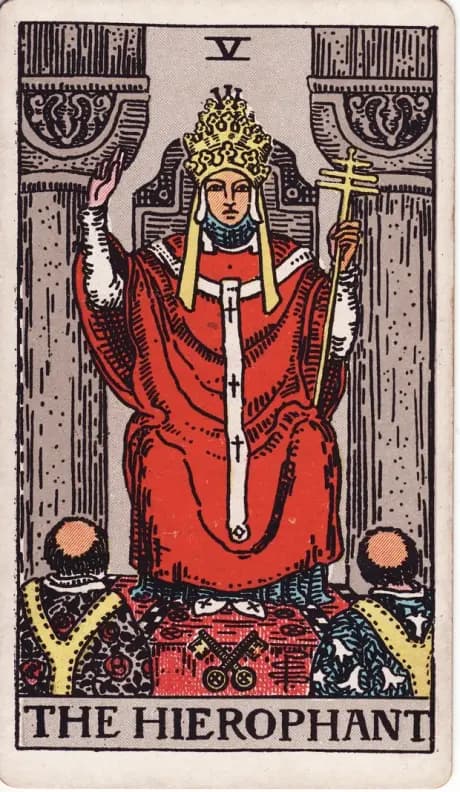
The 1909 card shows a robed religious figure seated high between two plain grey stone pillars, with two shaven-headed attendants standing below him, their backs to the viewer. Everything in the picture is arranged in a vertical line, and the arrangement is the meaning: authority above, transmission below.
He wears three layered vestments, red over blue over white, and a triple crown, and holds a staff topped with a triple cross in his left hand. Threes repeat all over the card. The usual reading is three worlds, or three levels of any teaching, but the plainer point is that everything he wears and carries has been formalised into a rank. Nothing about the costume is personal to him.
His right hand is raised in benediction with two fingers up and two folded down. Half shown, half hidden. What can be taught is being taught, something is being held back, and the card does not pretend otherwise.
At his feet lie two crossed keys, one gold and one silver. Keys mean access. They are lying on the floor rather than held in anyone's hand, which is the most honest detail on the card: the way in exists, it is not being withheld, and it is also not being handed to you. Somebody has to climb the steps and pick it up.
The two attendants wear robes patterned with roses and lilies, desire and purity, the same pair growing in the Magician's garden. They are the institution's next generation, and they are drawn small.
The pillars are unmarked. The High Priestess sits between lettered ones. His are blank grey stone, because nothing here is a secret. It is all written down, and it is all somebody else's writing.
Frequently asked
Is the Hierophant a yes for love?
+
Yes for serious, sanctioned, long-term commitment — the kind that gets announced. If you are asking about a casual spark or something you need to keep quiet, this card politely disapproves, and the disapproval is practical rather than moral: what you are describing is not a thing he can hold up in front of anyone.
What does the Hierophant mean in a new relationship?
+
It is moving toward structure quickly: definitions, introductions to family and friends, plans that assume a future. Old-school courtship energy at an old-school pace. Nobody is being kept as an option here, which lands as either a relief or an alarm depending entirely on what you have been used to.
Is the Hierophant a yes or a no?
+
Upright, yes, but conditionally: yes if you do it the standard way, through the proper channel, with the right people involved. Reversed it reads as no, and usually the block is a rule, an institution or a genuine mismatch in values rather than the outcome itself being impossible.
What should I do when I draw the Hierophant?
+
Find someone who has already done the thing you are trying to do and ask them how they did it. Then take one step that makes your own situation formal rather than implied: a stated commitment, a written agreement, a conversation with the people it affects. The card's argument is that anything which costs nothing to say costs nothing to walk away from.
Does the Hierophant mean marriage?
+
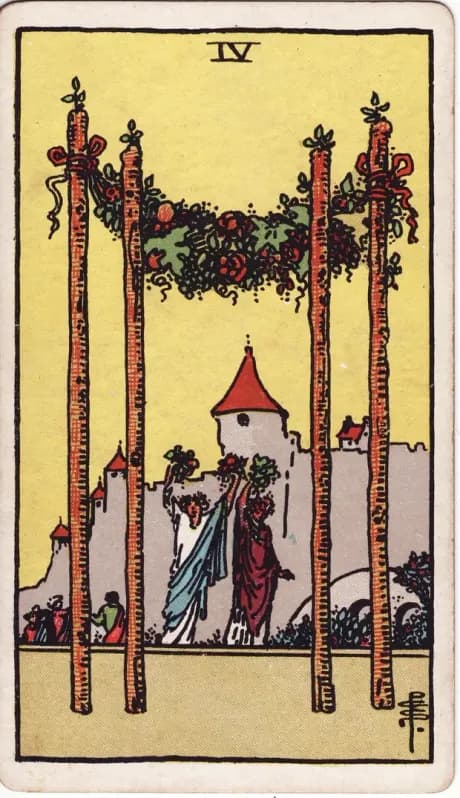
Often, yes. Along with the Four of Wands it is one of the deck's two clearest marriage cards, and it points at the formal, witnessed version rather than a private understanding. But it describes the machinery of commitment more than the wedding: shared values, obligations accepted in public, a promise made expensive on purpose. Beside the Two of Cups or the Ten of Cups, that reading firms up considerably.