What The Hanged Man means in tarot — and in love
The Hanged Man suspends the love story on purpose: a pause, a wait, a situation that refuses to resolve on your schedule. As feelings, the Hanged Man means they're in limbo about you — feelings exist but sit in suspension while they figure out life, timing, or themselves.
Jump to FAQAt a glance
- Yes or no
- No — reversed flips it
- Upright, in a line
- a pause, seeing them from a new angle
- Reversed, in a line
- stalling, sacrifice with no return
Want a yes or no on your own situation rather than this card? Pull one card and get the verdict with the reason behind it.
Ask your own yes-or-no questionUpright in love
The Hanged Man suspends the love story on purpose: a pause, a wait, a situation that refuses to resolve on your schedule. Its gift is perspective — hanging upside down, you finally see the relationship as it is, not as you narrate it. If you asked 'why is nothing moving?' — because the lesson isn't finished. Surrender the timeline; keep the clarity.
The suspension is the card, not an interruption of it. Almost everyone who draws this wants a date, and the card does not deal in dates. What it deals in is the distance between what you are doing and what is actually available, and that distance closes when something is understood rather than when enough weeks have passed.
In a new connection it usually describes something that will not quite begin. The messages keep arriving and the plans keep dissolving. Often the other person is unavailable in a way they have never spelled out — a job, a move, someone they have not finished ending things with — and the ambiguity is not cruelty. It is their own stall showing through the wall. You are in their pause with them, and it is not yours to end.
In an established bond it points inward more often than outward. There is a decision you are holding without making: whether to stay, whether to say the thing, whether to accept what this actually is. The card does not tell you the decision is wrong. It tells you that you will not make it from where you are currently standing, and that the effort you are pouring into forcing it is the exact thing keeping the view blocked.
What it asks for is narrow and unpleasant. Stop the pushing that has produced nothing — the check-ins, the strategies, the rewriting of what they meant — and use the stillness to look at the situation without editing it. Then set an end date for yourself and tell nobody. Waiting with your eyes open is the instruction. Waiting with your eyes closed is just hanging there.
Reversed in love
Reversed, the Hanged Man is sacrifice past its expiry date: waiting for someone who isn't coming, stalling a decision to avoid its cost, martyrdom mistaken for devotion. You've seen the view; hanging longer adds vertigo, not wisdom. Cut yourself down and walk with what you learned.
The reversal does not say the pause was a mistake. It says the pause has stopped producing anything. There is a point where suspension turns from a way of seeing into a way of avoiding, and the reversed card marks that point rather than everything that came before it. What you learned upright still counts. It simply does not need more months to keep counting.
The martyrdom reading deserves naming plainly, because it is common and it is flattering. Giving things up for someone feels like proof of how much you care. It is only proof if the other person knows what you gave, agreed to it, and is giving something back. A sacrifice made silently and then kept as a receipt is a debt you are collecting from someone who never signed for it, and they will feel the invoice long before they understand it.
There is a lighter version worth checking for before you assume the bleak one. Sometimes reversed means the wait is simply over. The thing that was blocking movement has cleared, the other person has landed, and the pause ends without ceremony or apology. If the cards around it are cards of motion, read it that way.
Either way the instruction is the same and it is physical. Get down. Make the decision you have been suspending, in the smallest concrete form available — one conversation, one message not sent, one plan made for yourself alone — and let the rest follow from a body that is the right way up.
The Hanged Man As feelings
As feelings, the Hanged Man means they're in limbo about you — feelings exist but sit in suspension while they figure out life, timing, or themselves. It's not rejection; it's a decision on pause. Don't build a home inside their maybe.
Suspension reads very differently depending on where you are standing in it, so it is worth taking the four situations people actually ask about one at a time.
If you are single and asking about someone new. They feel something and they have not let it move. Usually there is a specific reason they have not told you: an old attachment still being unpicked, a life in the middle of changing, a fear of starting something they might have to leave. The feeling is real. The availability is not there yet, and no amount of pressure manufactures it — pressure only makes them decide early, and early decisions in this card go the way that costs them least.
If you are in a relationship. They are re-examining rather than withdrawing, and from the outside those two look identical. They have gone quiet because they are looking at the pair of you from an angle they have not used before, and the quiet is the looking. This is uncomfortable and it is not the same as leaving. The version to watch for is when the examining stops being a phase and becomes the permanent temperature.
If you are asking about an ex. They are stuck between two positions and have chosen neither. They think about you, they do not act, and the not-acting is less about you than about an unwillingness to pay for either answer. Nothing you do reaches into that. They are the only person who can cut themselves down.
If you are asking about someone long-term. The card usually points at something they have suspended in themselves — work, a plan, a version of their life they quietly set aside — and you are feeling the stillness of it in the house. Their feeling for you is not what is on hold. Their movement is.
Across all four the card says one thing: the feeling is not the problem, and the feeling will not move the situation on its own.
The Hanged Man For your ex
For an ex, the Hanged Man suggests they see the relationship differently now — distance flipped the picture. They may be stuck between missing you and moving on, hanging in their own indecision. Your life shouldn't hang beside theirs.
What distance does to memory is the honest subject here. Away from the daily friction, they can finally see what the two of you were, and some of what they see is good. That new clarity is genuine. It is also cheap, because it costs them nothing to hold and commits them to nothing at all.
The specific trap of this card with an ex is that their suspension feels like hope from where you are sitting. Silence gets read as consideration. A vague message gets read as a step. Nothing is a step until it has a time and a place attached to it, and this is precisely the card of the person who has not attached one and is not about to.
There is one genuinely constructive version. Occasionally the card means both of you needed the interruption, and the pause has done real work — they understand something now that they could not have understood from inside it. Even then, understanding is where a reconciliation would start, not where it ends, and understanding on its own has never rebuilt anything.
The practical read: give it a limit that only you know about. Choose a date, write it somewhere private, and carry on with your life in the meantime rather than beside the phone. If nothing concrete has happened by then, the card has already told you what this was — a view, not a return.
What The Hanged Man means in general
The Hanged Man hangs by one foot from a living tree, upside down, apparently serene. His subject is the productive pause: a situation suspended, a wait that cannot be shortened, and the reversal of perspective that only becomes available once you stop struggling against the rope.
Upright he says surrender is the strategy. Not defeat — the deliberate release of control, usually paid for with something you would rather have kept. He is unusual in the deck for asking you to do nothing on purpose, and for treating that nothing as an action with a price rather than an absence of action.
Reversed the suspension has stopped being useful: stalling dressed up as patience, a self-denial nobody asked for, or a delay held so long that the original reason has been forgotten and only the habit is left holding the rope.
Read on a situation in general, he answers the question of why nothing is happening. Something is genuinely blocked, and the block does not respond to effort. Sometimes it is another party's timetable. Sometimes it is information that has not arrived yet. The wait is real, and the card flatly refuses to say how long.
At work he is the project frozen pending a decision two levels above you, the hiring freeze, the notice period where you have already gone and are still turning up. In money matters he is capital tied up and unusable, value that exists on paper and does nothing at all. In creative work he is the drawer where a manuscript sits for six months, which is either the best thing that ever happened to it or the way it quietly dies, and the difference is only whether anyone takes it out again.
He is the twelfth trump, sitting between Justice and Death: after the verdict, before the change. Nothing about him is passive. Hanging still while everything in you wants to thrash is work, and while it lasts it is the only work on offer.
The Hanged Man as a yes or no
As a yes or no, the Hanged Man upright is a no, and the honest phrasing is not yet. Nothing in the situation has finished happening. The card describes a state where an answer exists somewhere ahead but has not been reached, and pulling a verdict out of it early gives you a verdict about your own patience rather than about events.
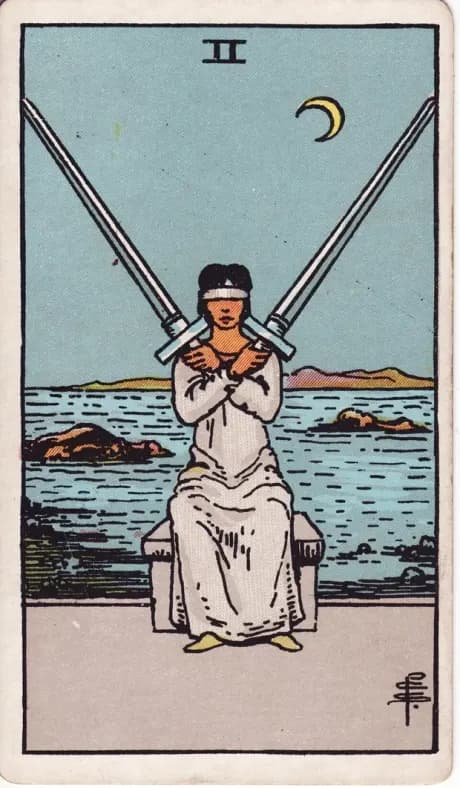
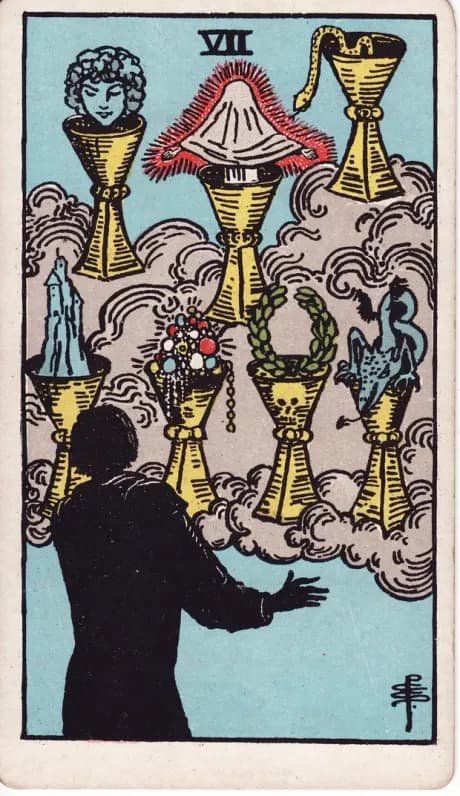
This is one of the few cards that genuinely fights the format. The Two of Swords and the Seven of Cups do the same. Most cards lean one way or the other; these three describe suspension, and a suspended situation returns a false yes as easily as a false no, because both answers assume that something has been decided.
Reversed it flips to yes, for a simple reason: the hanging is over. Something moves. That yes is often less pleasant than it sounds — the movement can be you leaving rather than the thing arriving — but it is a real answer where the upright card had none to give.
When this card lands on a yes-or-no question, the most useful thing you can do is change the question. Will they come back becomes what is actually holding this in place. Is it over becomes what am I still paying for. The deck answers the second kind well, and the Hanged Man is the card that says so most directly, by refusing the first kind outright.
One practical note. If you ask the same yes-or-no question again in a week and this card comes back, the repetition is the answer. The situation has not moved, and asking is not movement.
The Hanged Man as advice
As advice, the Hanged Man says stop. Not forever, and not as a punishment — stop the specific effort that has produced nothing, because the effort itself is now part of what is holding the picture still. Most people meet this card while working extremely hard at something. The instruction is to take your hands off it and see what the situation does when you are not pushing.
Concretely: stop initiating for a set period. Stop rehearsing conversations that have not happened. Stop checking. Write down what you actually know about the situation in one column and what you have assumed in another, and notice how short the first column is. That gap is what the card wants you looking at, and you cannot see it while you are busy.
The second instruction is to give something up on purpose. A position you have been defending, a version of the story in which you were entirely right, a demand for an apology that is not coming. The card is explicit that this costs something real. A surrender that costs nothing is not surrender, it is just waiting with better vocabulary.
Set a limit at the same time you begin. Choose a date and write it somewhere only you will see. This card honours patience with a purpose and has nothing good to say about a person still hanging two years later because nobody ever told them they were allowed to get down.
Reversed, the advice inverts and becomes easier to hear. You already know. Cut the rope, make the decision, act on what the pause showed you. Whatever you were going to learn up there, you learned it a while ago and have been paying rent on the view ever since.
The Hanged Man as an outcome
As an outcome, the Hanged Man is a situation that does not resolve inside the window you asked about. Nothing breaks and nothing lands. That is a real result rather than the deck declining to answer: it means the thing you are watching stays open, and any plan you make should assume it stays open instead of assuming it closes in either direction.
In a question about two people, this usually looks like continuation without definition. Contact carries on. Nothing gets named. Neither person ends it and neither commits, and the state is stable precisely because it is comfortable enough for both of them not to force it.
There is a better version of the same result. Sometimes the outcome is that you come out of the wait seeing the situation clearly for the first time, and the clarity is the whole prize. You do not get the thing you asked for. You get an accurate picture of whether you wanted it, which is worth more and feels considerably worse.
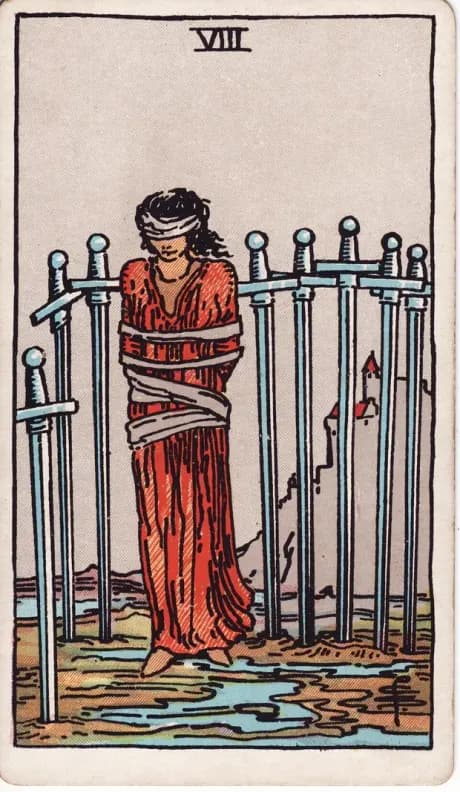
What sits beside it decides which one you are reading. Cards of motion — the Chariot, the Eight of Wands, any Ace — pull it toward a pause that ends. Static company such as the Four of Cups, the Two of Swords or the Eight of Swords pulls it toward a pause that has quietly become the arrangement itself.
Reversed as an outcome, the suspension ends. Someone gets down. That can be a resolution or it can be an exit, and the card does not promise the ending is the one you wanted — only that the waiting stops. After a long upright stretch, most people find they prefer an ending to more waiting, and are surprised by how much lighter it is.
What the The Hanged Man card shows
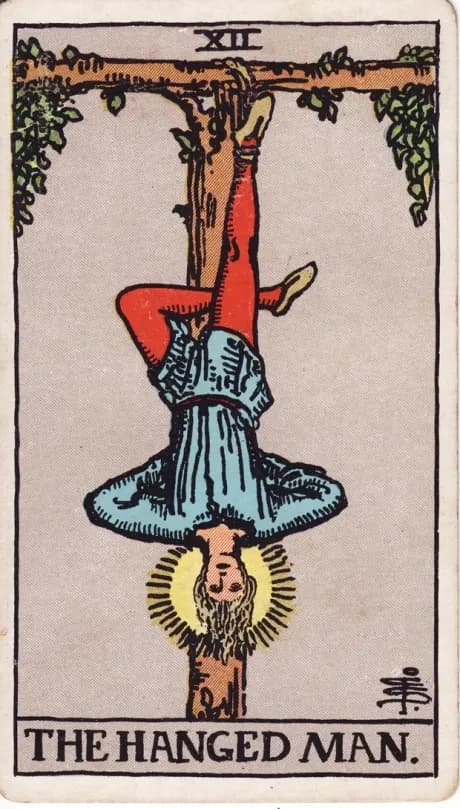
The 1909 card shows a young man suspended by one ankle from a wooden beam. The beam and its two uprights are living wood: you can see the cut stubs of branches and small leaves still growing out of them. The gallows is a tree, and the tree is alive.
He hangs from his right ankle. His left leg is bent behind the right knee, making the shape of the numeral four. His arms are behind his back with the elbows out, which makes a triangle. A four above a triangle, both inverted — this is a deliberate figure, not a body in distress.
His face is the part most people miss. He is not straining and not grimacing. His expression is calm to the point of mild interest, and around his head is a bright yellow nimbus of light. Whatever is happening to him is happening in his head, and it appears to be going well.
He wears a blue tunic and red hose. This deck uses those two colours consistently: blue for what is known and thought, red for what is wanted and done. The body is in red and immobilised. The mind is in blue, and it is the only part of him still working.
The most important detail is the rope. It binds one ankle. The other leg is free, his hands are behind him but not tied, and the ground is not far below his head. He is not chained and he is not nailed. He is in a position he could leave and has chosen not to, which is the entire difference between this card and the Devil.
The background is plain, with a strip of grass at the foot of the uprights. No landscape, no horizon, no weather, nothing else in the frame to look at. Which is roughly what being suspended is like from the inside.
Frequently asked
What does the Hanged Man mean in love?
+
A necessary pause and a change of perspective. The relationship isn't dead — it's suspended while someone learns something, and often that someone is not you. Expect no movement for now, and use the stillness to see the situation without the story you usually tell about it.
Should I wait for them if I pull the Hanged Man?
+
Wait only with a deadline. The card honors patience with purpose, not indefinite hanging around someone's maybe. Set the date privately, do not announce it, and carry on with your own life in the meantime. If the date passes with nothing concrete, the card has already answered.
Is the Hanged Man a yes or a no?
+
Upright it reads as a no, though not yet is more accurate — the situation has not finished happening, so any verdict would be about your patience rather than about events. Reversed it becomes a yes, because the pause ends and something finally moves.
What should I do when I draw the Hanged Man?
+
Stop the effort that has produced nothing, and give something up on purpose: a position, a demand, the version of events where you were entirely right. Then set a private end date. This card rewards patience that has a direction and punishes patience that has none.
How long does the Hanged Man last?
+
It refuses to say, and the refusal is part of the meaning — the wait is measured in what has not been understood yet, not in weeks. Treat it as lasting until something you can point to actually changes, and give yourself a date at which you stop waiting regardless of what has changed.