What Death means in tarot — and in love
Death in love isn't a funeral — it's a door. As feelings, Death means their emotions have fundamentally shifted — old feelings ended, or something new is replacing what was.
Jump to FAQAt a glance
- Yes or no
- No — reversed flips it
- Upright, in a line
- an ending that makes room for real love
- Reversed, in a line
- clinging to what is over, resisting change
Want a yes or no on your own situation rather than this card? Pull one card and get the verdict with the reason behind it.
Ask your own yes-or-no questionUpright in love
Death in love isn't a funeral — it's a door. Something ends so something true can start: a relationship phase, an attachment to an ex, a version of you that settled for crumbs. The transformation is non-negotiable; only your grip is optional. If you asked about a fading connection: let what's over be over. Every real next love starts at this door.
The word people hear is loss. The word the card is using is finished. Those are not the same thing. Something has already ended, usually weeks or months before the question got asked, and the card is not announcing it so much as saying it out loud for the first time. The only part still in progress is your agreement with the fact.
In a new connection it rarely means the connection itself is over. More often something you carried into it has to go: a rule you made after being hurt, a habit left over from the last person, an idea of what you are worth that was set by someone who is no longer in your life. The new thing cannot start while you are running the old thing's instructions and calling it caution.
In an established relationship it points at a phase ending rather than the whole. The version of the two of you that worked at the beginning has stopped working, and no amount of effort restores it, because it was built for two people who no longer exist in that form. What follows can be better. It will not be a restoration, and treating it as one is how couples spend years trying to reopen a room that was demolished.
What the card asks is unglamorous: attend the ending. Say plainly what is over, to yourself at minimum. Stop maintaining the parts that survive only out of habit. Grief here is not the obstacle, it is the process working correctly. The obstacle is negotiation, and this card does not take offers.
Reversed in love
Reversed, Death is the refusal to bury what's already gone: half-dead relationships on life support, exes kept warm as backup plans, grief postponed until it grows interest. The ending stands whether or not you attend it. Resisting costs more than the loss itself — release your grip and let the new thing find your empty hands.
The reversal does not cancel the ending. Nothing in this card is negotiable in that direction. What reverses is your position toward it. Upright you are moving through the change; reversed you are braced against it, and the cost of bracing accumulates in a way the change itself does not.
The most common shape is a stall halfway. The old arrangement is over in every way that counts and is still being performed — the messages, the birthday, the shared plans nobody has cancelled. Both people know. Neither says. This is the specific misery the reversed card describes, and it is worse than the ending it exists to avoid, because an ending finishes and this does not.
There is a gentler reading and it is real. Sometimes reversed means the change is happening slowly and you are surviving it: resistance loosening, the first honest week, a loss finally being felt rather than managed. If the cards around it are calm ones, read it that way and stop demanding speed from yourself.
The instruction either way is to stop paying maintenance on something that is not alive. Delete the draft. Return the key. Take the photograph down for a while. It is not a punishment and it is not disrespect to what happened. It is the only condition under which anything else gets room to arrive.
Death As feelings
As feelings, Death means their emotions have fundamentally shifted — old feelings ended, or something new is replacing what was. Whatever you're nostalgic for, they've already left that room. Meet who they are now or not at all.
That shift lands very differently depending on which question is being asked, so here are the four people usually asking it.
If you are single and asking about someone new. Something in them has recently closed: a chapter, an attachment, a way of seeing themselves. You are meeting the person on the far side of it. This is either excellent timing or terrible timing, and the difference is whether the ending is finished or still under way. Someone in the middle of one will feel intense and be unavailable, and both of those are honest.
If you are in a relationship. Their feeling has changed form rather than amount. The early charge is gone and something steadier or something colder has taken its place, and this card alone does not tell you which without help from its neighbours. What it does tell you is that the previous version is not coming back, so any conversation aimed at restoring it will land in an empty room.
If you are asking about an ex. They have closed the file. Not with hostility, usually, but with finality. They may still have warmth for you, and it is the warmth people keep for the past rather than a door left open. The hard part of this reading is that it is not a rejection you can argue with. It is a completed process, and there is nobody to appeal to.
If you are asking about someone long-term. Something is ending in them that may have very little to do with you: a career, an identity, a belief about how their life was going to go. You feel it as distance. Read it as weather in their house rather than a verdict on yours, at least until they tell you otherwise.
In every case the card says one thing. Whoever they were when you last measured them, that measurement is out of date.
Death For your ex
For an ex, Death is the closure card: that chapter is complete, even if the goodbye never got said aloud. Any future between you would be a genuinely new relationship between two changed people — the old one doesn't resurrect.
This is the card people least want and most often need, because it removes the specific hope that keeps a person stuck: the hope of return. Not of contact — contact happens all the time and means less than it feels like — but of return to the thing as it was. That version had a final day, it has already passed, and nobody was told which day it was.
The reunion question deserves a straight answer. Death does not forbid a reunion. It forbids a resumption. If the two of you were to build something again it would start from nothing, on new terms, between people who have both changed in ways the other was not present for. Anyone who goes back expecting to pick up where it stopped is going back to a place that is not there.
There is a practical tell worth using. Notice whether you miss the person or miss the period of your life. The two feel identical from inside and behave completely differently: missing a person survives contact with the actual person, and missing a time does not — it gets worse with contact, because the real one keeps failing to be the memory.
What the card wants from you is small and hard. Finish it privately. Write the thing you never got to say and do not send it. Closure that depends on their participation is not closure; it is one more request, and this card is about the requests being over.
What Death means in general
Death is almost never literal and almost always non-negotiable. It is the card of endings that clear ground: the chapter finished, the identity outgrown, the arrangement that cannot be renegotiated back into existence. It is a clean card, more surgical than tragic, and it is the thirteenth trump — the point where the deck stops describing circumstances and starts describing change.
Upright it says the transformation is already under way and resistance only lengthens it. What is being lost was going to be lost. The space it leaves behind is the actual subject, and the card is indifferent to whether you approve of the timing, because it reports rather than proposes.
Reversed the ending is being fought. The transition stalls halfway, so the old thing is gone and the new one has not been allowed to begin: decay in the place where change belonged. Reversed is the only version of this card that is genuinely bleak.
Read on a situation in general, it means the question of whether is settled and only the question of how gracefully is left. It is worth checking carefully what is actually ending, because people assume it is the largest thing in view and it usually is not. What dies is often a role, a story or a method rather than the thing itself.
At work it is the job you have already left in your head, the product being shut down, the restructure that makes your old function meaningless. In money matters it is the arrangement that stopped working and is still being funded. In creative work it is the draft that has to be abandoned instead of rescued — every experienced maker knows the particular relief of deleting forty pages, and every inexperienced one knows the month spent editing something that was dead on arrival.
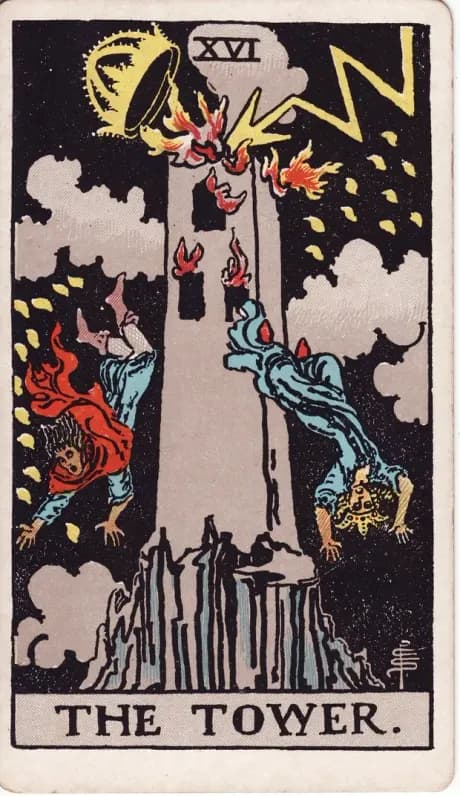
The skeleton in the picture rides at a walking pace. Nothing here is sudden; that is the Tower's job. This card simply keeps coming, in a straight line, at the same speed, whatever stands in front of it.
Death as a yes or no
As a yes or no, Death upright is a no, and one of the deck's most definite. The card describes something that has finished. Whatever you were hoping would continue, continuing is precisely what it rules out. If the question was whether this goes back to how it was, the answer is not merely no — the option expired before you asked.
There is one kind of question it answers with a strong yes, and it is usually the better question. Is it over: yes. Is this a real ending rather than a rough patch: yes. Am I right that something changed and nobody said so: yes. The no and the yes are the same fact approached from two directions, and the second direction is more useful to you.
Reversed it becomes a yes, which surprises people who expect a reversal to soften a card rather than reopen it. The logic is that the ending is being resisted, and where there is resistance something is still in play. The yes it offers is conditional and joyless: yes, this can continue, at the price of continuing to hold up something that is not alive on its own.
The practical move is to stop asking about survival and start asking about form. What survives this. What comes after it. Which part is actually ending. Death answers all three of those well, and answers will it stay the same with the same word every single time.
One thing this card never means: a forecast of anyone dying. The deck is not used that way here, and questions about health belong with a doctor rather than a reader.
Death as advice
As advice, Death says finish it. Whatever you have been keeping half alive out of politeness, hope or habit, end it properly and on purpose, because the version where you let it fade takes longer and costs more. The card is not asking for a dramatic gesture. It is asking for a decision that is actually made rather than drifted into over a year.
Concretely, that means removing the infrastructure. Cancel the standing arrangement. Take the thing off the list. Stop the small maintenance acts that keep a finished situation technically running — the check-in, the shared login, the plan neither of you intends to keep. Each one is a vote for the old arrangement, and together they are the reason it will not lie down.
The second half of the advice is to leave the space empty for a while. The strong instinct after an ending is to fill it immediately, and the card is unusually clear that the emptiness is the useful part. Anything installed in the first week is generally a replacement for the old thing rather than a new thing, and it inherits all the old thing's shape.
Do not confuse any of this with cutting off everything. The card is precise about what is finished, and reading it as permission for scorched earth is how people lose things that were still alive. Identify the actual corpse. Bury that. Leave the rest standing.
Reversed, the advice is simply to stop arguing with what has already happened. You are not being asked to like it, or to be finished grieving, or to be gracious about the timing. You are being asked to stop funding the upkeep of something that ended without your permission and is not going to ask for it.
Death as an outcome
As an outcome, Death is a definite ending followed by open ground. The situation you asked about closes. What separates this from the deck's other endings is that it does not report damage — it reports completion, and the state afterwards is clear rather than wrecked.
In a question about two people, it usually means the current arrangement will not be the arrangement six months from now. That is not automatically a separation, though it can be. Just as often it is the end of a phase: an ambiguity ends, a long distance ends, a role one of you had been playing ends. Something concrete stops being true.
The part people underweight is what comes next. Temperance follows this card immediately in the sequence, and the deck says the same thing every time by that arrangement: the ending is not the destination, it is the clearing before a slow rebuild. Outcomes with this card in them keep going after the ending, and the going is where the result actually lives.
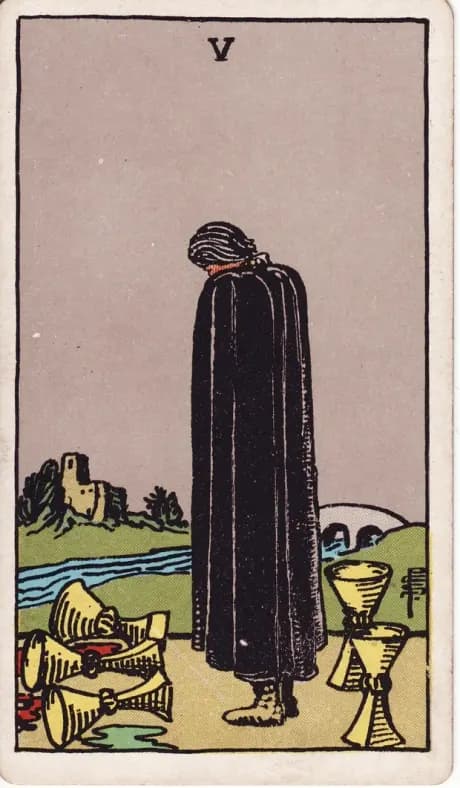
Neighbours matter here more than usual. With the Star, the Sun or an Ace, the cleared ground gets built on quickly. With the Five of Cups, the Four of Cups or the Nine of Swords, the ending arrives and a long stretch of looking backwards arrives with it, which is a different outcome wearing the same face.
Reversed as an outcome is the least comfortable result in this card's range: the situation does not end, and it does not live either. It continues in a reduced form, funded by somebody's refusal to close it. If that is the result, the useful question is who is paying — reversed Death always has someone paying, and it is worth knowing whether that someone is you.
What the Death card shows
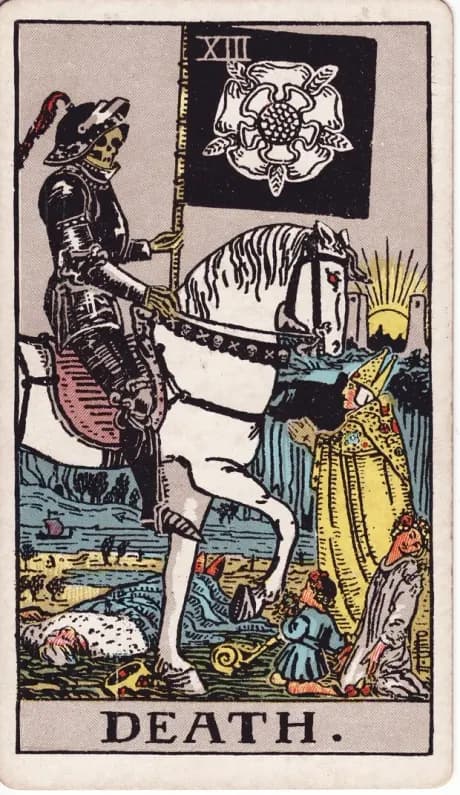
The 1909 card shows a skeleton in black armour riding a white horse at a walk. He carries a black banner with a white rose of five petals on it. Nothing about his pace suggests urgency, and that is the first thing to notice: this rider does not need to hurry.
Four figures meet him, and they are the argument of the card. A king lies dead beneath the hooves, his crown fallen off beside him — rank did not exempt him and did not get him a warning. A bishop in a golden mitre stands in front of the horse with his hands together, the only figure upright and facing it, and the only one negotiating. A young woman kneels half turned away, head averted, unable to look. A child kneels at the front holding flowers and looks straight up at the rider.
Four responses to one fact: crushed, negotiating, unable to watch, and simply curious. The child is the only comfortable one, which is not sentimentality about innocence. It is a note about how much of the fear comes from having something you had planned to keep.
The banner matters more than the armour. A white five-petalled rose on black is not a symbol of death in this deck — it is the same rose the Fool carries at the start of the sequence. It reads as life, and it is the only bright thing the rider brings with him.
In the background a river runs, with a small boat on it. Beyond the far bank, between two towers, the sun sits on the horizon. Waite described it as rising. The picture itself does not distinguish a sunrise from a sunset, and the card is more honest if you notice that it does not.
One last detail. Skeletons do not need armour. This one is dressed for a fight that nobody in the picture is going to win.
Frequently asked
Does the Death card mean a breakup?
+
Sometimes — always transformation. An ending arrives, but it's the kind that clears ground for real growth or new love. Just as often what ends is a phase, a role or an assumption inside the relationship rather than the relationship itself, so read what is actually finished before assuming it is everything.
Is the Death card bad in a love reading?
+
No. It's honest. It removes what was already finished. The pain is real; so is the space it opens. What makes it hard is not cruelty but timing — the card confirms an ending that usually happened before the question was asked, and confirmation is the part nobody wants.
Is the Death card a yes or a no?
+
Upright it is a firm no to anything that depends on things staying the same, and a firm yes to the question is it over. Reversed it becomes a yes, but a joyless one: the ending is being resisted, so the situation continues in a form somebody has to keep holding up.
What should I do when I draw the Death card?
+
Finish something on purpose rather than letting it fade. Cancel the standing arrangement, stop the small acts of maintenance that keep a finished thing technically running, and then leave the space empty for a while instead of filling it in the first week.
Does the Death card mean someone is going to die?
+
No. It is the most misread card in the deck and it does not forecast anyone's death. Love Oracle is for entertainment and does not predict events, and questions about health or dying belong with a doctor rather than with a tarot reading.