What Eight of Swords means in tarot — and in love
The Eight of Swords is the self-built cage: feeling trapped in a situation your own thoughts are guarding — can't leave, can't speak, can't choose,… As feelings, the Eight of Swords means they feel trapped — by circumstances, obligations, or their own catastrophizing about you two.
Jump to FAQAt a glance
- Yes or no
- No — reversed flips it
- Element
- Air
- Upright, in a line
- feeling trapped by thoughts, not facts
- Reversed, in a line
- freeing yourself from a mental cage
Want a yes or no on your own situation rather than this card? Pull one card and get the verdict with the reason behind it.
Ask your own yes-or-no questionIn the Golden Dawn tradition this card rules 0–10° of Gemini. A planet standing at that degree is read through it: Venus in Gemini · Moon in Gemini · Mars in Gemini
Upright in love
The Eight of Swords is the self-built cage: feeling trapped in a situation your own thoughts are guarding — can't leave, can't speak, can't choose, because every exit is staffed by a fear. The ropes are real feelings and imagined walls. If you asked 'why am I stuck?' — look at who tied the blindfold. The gate was never locked; it was believed locked.
The card is usually summarised as 'it is all in your head', and that summary is popular and slightly wrong. Some of what holds you is real. Distance is real, other people's choices are real, the timing of a life is real. What the card actually says is narrower and more useful: you have stopped counting your options, and the number you are working from was set some time ago by a fear rather than by a check.
In a new connection it shows up as a set of rules nobody agreed to. You cannot message first. You cannot ask what this is. You cannot say you want something more definite, because saying it would end the thing. None of that has been tested against this particular person. It is a script assembled from earlier people, and the one in front of you has not read it and does not know it exists.
In an established relationship it is heavier and slower. A subject becomes unmentionable, then two subjects, then a whole category. Nobody made that rule. It accumulated, one avoided evening at a time, until the space left to talk in is small and both people are guarding a cage neither of them built on purpose. The bindings here are politeness and history, which are harder to see than hostility and just as effective.
What the card asks for is small and specific. Test one wall, not all of them. Say the smaller true thing and watch what actually happens rather than what you predicted would happen. The figure on the card does not need to run anywhere. She needs three steps forward, which is all the gap in front of her requires.
Reversed in love
Reversed, the Eight of Swords is the first step out: limiting beliefs dropping, victim story retired, the discovery that walking away — or speaking up — was always available. Freedom feels wobbly after a cage. Take it anyway; captivity had worse hours.
What the reversal changes is authority, not circumstances. The facts of your situation are often identical the day after this card and the day before. What has moved is that a belief you were treating as a law has been demoted to an opinion, and opinions can be argued with. That is the whole difference, and it is enough, because almost everything the upright card describes was being enforced by that belief alone.
The first honest feeling here is frequently not relief. It is anger about the time. Discovering that the door opened inward is a good discovery and a humiliating one, and people often skip the discovery to avoid the humiliation. Let it be both. The alternative is another year spent proving the door was locked.
In a relationship the reversal usually looks like one plain sentence finally said out loud, and a response that is nothing like the catastrophe rehearsed for months. Sometimes the response is bad. That is still progress, because a real answer can be acted on and an imagined one cannot.
There is a colder version of the reversal and it should be named. Occasionally it means the binding tightening rather than loosening — the story hardening into an identity, the restriction becoming something a person now defends. The tell is simple. If every proposed way out is answered before it has finished being said, the cage has acquired a tenant who is decorating.
Eight of Swords As feelings
As feelings, the Eight of Swords means they feel trapped — by circumstances, obligations, or their own catastrophizing about you two. Paralysis, not absence of feeling. They want moves they believe they can't make.
If you are single and asking about someone new. They are interested and they have talked themselves out of acting on it. The reasons will sound structural — bad timing, work, something unfinished elsewhere — and one of them may even be true, but the shape is a person waiting for permission that nobody is going to issue. Directness helps here more than patience does.
If you are in a relationship. They feel penned in, and the important question is by what. Sometimes it is the relationship. More often it is everything else — money, family, a life that got narrow — and the relationship is simply the nearest wall to press against. Ask which it is, plainly, because the two look identical from the outside and need opposite responses.
If you are asking about an ex. They want contact and have decided it is not allowed. The prohibition is self-issued and is being experienced as a rule imposed from outside. This is why people under this card go quiet for months and then send something at two in the morning. The rule holds until it does not, and nothing in between was a decision.
If you are asking about someone long-term. Here it tends to mean a person who no longer believes change is possible in the thing you share. Not unhappy exactly. Resigned, which is quieter and more dangerous, because resignation does not complain and therefore never gets addressed.
Across all four, the card never says they do not care. It says caring has been separated from doing, and the separation is held in place by something they think they are not allowed to question.
Eight of Swords For your ex
For an ex, the Eight of Swords means mental imprisonment around the breakup: overthinking, fear-blocked action, wanting contact and believing it forbidden. They may free themselves eventually. Your life shouldn't wait in visitor parking.
The cage in this case is usually built from a story about what reaching out would mean. That it would be pathetic. That it would reopen something. That there is a correct amount of time and it has not elapsed. None of these are facts about you. They are rules a person wrote for themselves after a difficult few months, and they are being obeyed with the seriousness usually reserved for law.
This is one of the cards most likely to be describing both people at once. If you are asking, there is a fair chance you are also standing inside a small circle of swords with a wide gap in it, running the same calculation from the other side. Two people can be held by the same imagined rule and each assume the other one wrote it.
The practical read is unglamorous. Somebody has to test it, and the test is one plain message with no machinery attached — not a hook, not a reply to a story, not something engineered to be deniable later. If you send it, send it because you want the information, not because you want a particular answer. If the answer is silence, that is information too, and it is worth more than another six weeks of modelling.
What this card does not support is waiting. Nothing in the picture resolves on its own, and the swords do not rust.
What Eight of Swords means in general
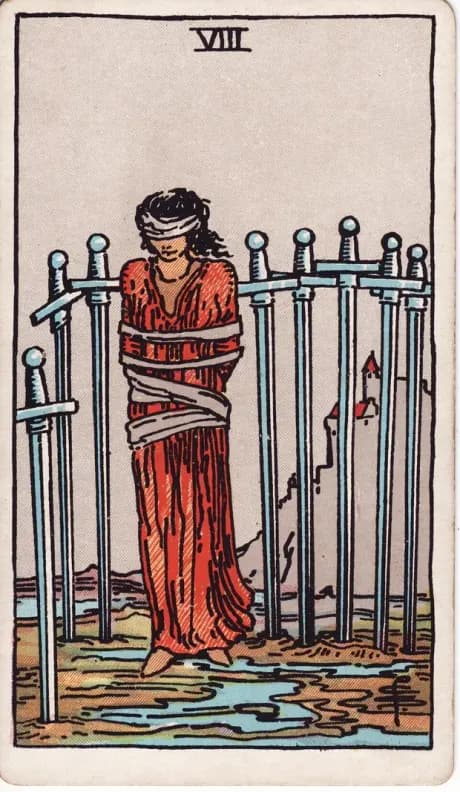
A bound and blindfolded figure stands among eight swords planted in the ground, and there is a clear gap in front of her. Nobody is watching. The card's subject is restriction that is mostly maintained by belief: a limit that feels total, has never been tested, and survives precisely because it is never tested.
Upright it says the difficulty is genuine and the count of available options is wrong. Both halves matter. Telling somebody their problem is imaginary is not what this card does. It says the problem is smaller than the perimeter drawn around it.
Reversed the bindings loosen. A limit gets questioned, a way through is found, or — less kindly — the realisation arrives of how long the way through has been open.
In work it is the role that feels impossible to leave for reasons that have never been written down, or a deadline treated as physics when it was set by a person who would move it if asked. In business it is the rule everyone follows and nobody can source. In creative life it is the instruction from an early teacher, absorbed at twenty and still obeyed at forty, quietly deciding what you will not attempt.
Eights across the deck are about effort under pressure. The Eight of Wands moves fast. The Eight of Cups walks away. The Eight of Pentacles repeats a skill until it holds. The Eight of Swords is the one that spends all of its effort standing still.
The tell is a question with no answer. If you cannot say who told you that you were not allowed, and you cannot remember checking, you are looking at this card rather than at a wall.
Eight of Swords as a yes or no
As a yes or no, the Eight of Swords upright is a no, and it is a no with an unusual origin: it is being produced by the person asking. The card describes a situation where the available answers have been narrowed by fear rather than by events, so the verdict it returns is honest about your current position and unreliable about what is actually possible.
That distinction is worth holding onto. Most no cards describe an obstacle. This one describes a perimeter, and perimeters can be walked out of. If the question was whether something will happen while you carry on doing exactly what you are doing now, the answer is no. If the question was whether it could happen at all, the card does not say.
Reversed it flips to yes, and the reason is straightforward. The reversal is the moment the restriction stops being treated as permanent, and a situation you can move in is a situation that can produce a yes. The reversed yes is not a promise that the result will be good. It is a statement that the result is back in play.
The better question here is not about the future at all. Ask what you have decided is impossible, and when you last checked. The deck answers that well. It answers 'will it happen' badly under this card, because the card's entire subject is a person who has stopped gathering the information that would make the answer knowable.
Eight of Swords as advice
As advice, the Eight of Swords says: test a wall. One, not all of them, and preferably not the biggest one first. The card's argument is that most of what is holding you has never been checked, and the only thing that changes a belief is contact with the world.
The concrete forms are dull and effective. Say the sentence you have decided you are not allowed to say, and say the short version of it. Ask the direct question instead of building a model of the answer. Tell one person the actual situation out loud, because describing a restriction to somebody else is the fastest audit available — you will hear which parts are real as they leave your mouth.
There is a second instruction, and it is the one people skip. Stop waiting to be released. Nobody in the picture is coming. The castle on the hill is empty of anyone who has your situation in mind, and the most expensive habit this card describes is the belief that the right circumstances, the right message, or the right change in somebody else will do the work of a decision.
Reversed, the advice compresses. Move while it is clear. Clarity under this card is not permanent — the story is well practised and will reassemble inside a week — so do the small irreversible thing now. Send it, book it, say it, leave the room. Later is when the blindfold goes back on.
Eight of Swords as an outcome
As an outcome, the Eight of Swords is a situation that stays exactly where it is. Nothing arrives to end it and nothing arrives to fix it. That is a genuine result rather than a refusal to answer, and it is worth reading literally: whatever you are asking about does not resolve itself inside the window you asked about, because resolution needs a move that nobody in the picture is currently making.
This lands hardest on questions phrased as waiting. Will they come round. Will it get easier. Will the situation change on its own. The card's answer to all three is that the mechanism you are relying on does not exist. The swords do not fall over. The rope does not fray.
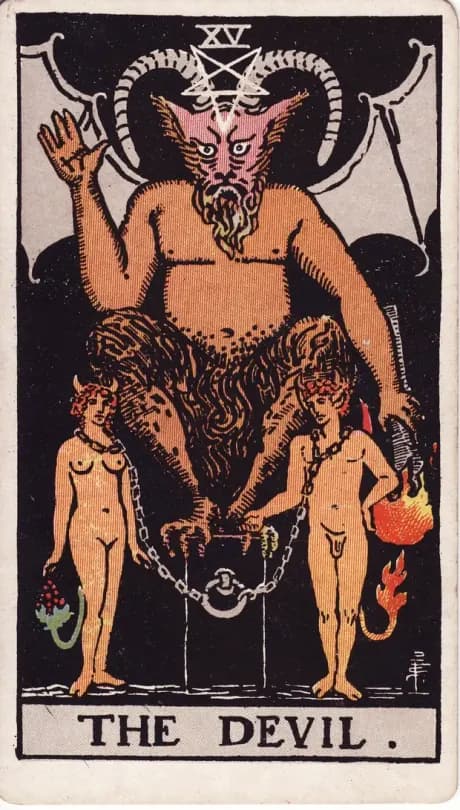
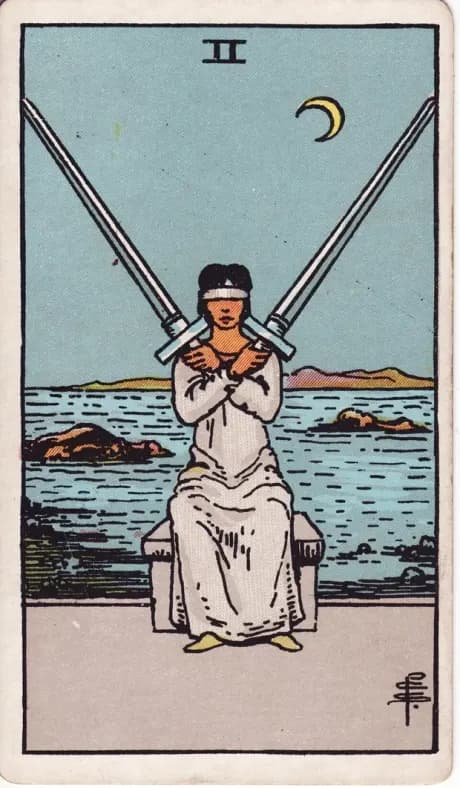
Surrounding cards say who moves first. Active company — the Knights, the Chariot, the Ace of Swords, the Eight of Wands — suggests somebody breaks the stalemate, and it is usually the person asking. Static company — the Two of Swords, the Hanged Man, the Four of Cups, the Devil — suggests a long stay.
Reversed as an outcome is one of the more satisfying results in the suit and also one of the quietest. The situation opens, and it opens smaller than expected. There is rarely a scene. Somebody says something plain, or simply walks out of a room they had been treating as locked, and afterwards the whole thing looks so ordinary that it is hard to explain to anyone what took so long. That embarrassment is the standard ending of this card, and it is a good one.
What the Eight of Swords card shows
A woman stands alone in a red dress, wrapped from shoulders to hips in a pale grey binding, with a white cloth tied over her eyes. Eight swords are stuck point-first into the ground around her, four to each side, standing upright like a fence.
The fence is the argument of the card, and it repays a close look. It does not enclose her. There is a wide clear gap directly in front of her, facing the viewer, and another one behind. Nothing about the arrangement prevents her from walking out. It only prevents her from walking out without touching anything, which is a different problem and a much smaller one.
Her feet are bare and unbound. Whatever holds her arms, nothing holds her legs, and she is standing rather than kneeling. The binding itself is loose. It wraps rather than ties, and in most printings the cloth is already trailing.
The ground is wet. There are pools of standing water around her feet and the earth reads as marshy, which makes the way out uncomfortable and slow but not closed. Discomfort and impossibility are drawn here as two different things.
Behind her, on higher ground, sits a grey castle. It is at a distance and slightly above her, and it is completely shut — no open gate, no figure at a window, nobody visible anywhere in the picture except her. There is no jailer in this scene. Whatever authority put her here is either absent or was never real, and the card declines to say which.
The sky is a flat pale yellow with no weather in it. Nothing is happening. That emptiness is deliberate. The only thing that is going to change this picture is the woman, and she is facing an opening she cannot see.
Frequently asked
What does the Eight of Swords mean in love?
+
Feeling trapped by thoughts more than facts — restriction that loosens the moment beliefs are questioned. It rarely describes another person holding you in place. It describes a set of rules about what you are allowed to say or ask, assembled from earlier experiences and applied to somebody who never agreed to them.
How do I get unstuck with the Eight of Swords?
+
Test the walls: say the thing, ask directly, take one small forbidden-feeling step. The bindings are looser than advertised. Pick the cheapest wall first — a question rather than an ultimatum — because the point of the first move is to collect evidence that the world does not end, not to settle everything at once.
Is the Eight of Swords a yes or a no?
+
Upright it is a no, with the caveat that the no describes your current position rather than what is possible. Nothing happens while everybody stands still. Reversed it flips to yes: the restriction stops being treated as fixed, and a situation you can move in is one that can produce a real result.
What should I do when I draw the Eight of Swords?
+
Write down the thing you believe you cannot do, then write down who told you so and when you last checked. Most of the time both answers come out blank, and that blankness is the reading. Then do the smallest version of the forbidden thing within a day, before the story reassembles itself.
Does the Eight of Swords mean someone is controlling me?
+
Usually not, but the card cannot tell the difference on its own and it should not be asked to. It describes the experience of being restricted, which feels identical whether the restriction is self-issued or imposed by somebody else. If a real person is limiting where you go, what you say or who you see, that is not a belief to be tested — describe it to somebody you trust outside the situation.