What Queen of Swords means in tarot — and in love
The Queen of Swords is love with the fog removed: clear boundaries, honest words, affection that never requires self-deception. As feelings, the Queen of Swords means measured assessment — they feel with the head consulted first: respect, clear-eyed interest, zero delusion.
Jump to FAQAt a glance
- Yes or no
- No — reversed flips it
- Element
- Air
- Upright, in a line
- clear boundaries, honesty over comfort
- Reversed, in a line
- bitterness, ice where warmth was
Want a yes or no on your own situation rather than this card? Pull one card and get the verdict with the reason behind it.
Ask your own yes-or-no questionUpright in love
The Queen of Swords is love with the fog removed: clear boundaries, honest words, affection that never requires self-deception. She's the energy of loving smart after loving blind — standards enforced kindly, truth preferred to comfort. If you asked how to handle it: say exactly what you mean and accept only the same. Alone-and-clear beats coupled-and-confused.
Her clarity is not a personality trait, it is a result. Every Queen of Swords has a history, and the history is why she can tell in two weeks what used to take her two years. That is worth saying plainly, because the card gets read as coldness by people who have not had to learn what she learned. She is not withholding warmth. She has stopped spending it on situations that were never going to return any.
In a new connection she asks the real question early and does not decorate it. What do you want, are you seeing other people, where is this going. To anyone used to a slower dance it reads as intense, and it is in fact the opposite of intense — it is an attempt to find out quickly whether this is worth being intense about. If you are the one drawing her, the instruction is to ask. If she describes someone else, expect to be assessed, fairly, and then told the verdict.
In an established relationship she is the conversation you have both been avoiding, held properly. Not a fight: a conversation with a subject, conducted in daylight, where both people say true things and nobody wins. Couples who draw this card are usually not in danger from the subject. They are in danger from how long the subject has gone unnamed.
What she asks of you is that you stop translating. Stop softening the sentence until it means nothing, stop testing people with hints, stop deciding what somebody meant instead of asking them. Say the plain version once. Then — and this is the half people skip — believe the plain answer you get back.
Reversed in love
Reversed, the Queen of Swords is the blade turned bitter: coldness as armor, cynicism taxing every new person for an old one's crimes, criticism replacing conversation. Ice is scar tissue here. The heart behind it isn't gone — it's unpaid. Warmth returns where honesty is finally safe.
The reversal keeps the accuracy and loses the use of it. She is still right about people, which is what makes this version so difficult to argue with. The reading is correct and the conclusion was written in advance: everyone will eventually do what the last one did, and any evidence to the contrary is simply an earlier stage of the same story. Being right becomes a way of never having to risk anything again.
It also appears as the criticism that has replaced the conversation. Small precise remarks, delivered accurately, technically about the dishes. Each one is defensible on its own. Together they are a person saying "I am not happy" in the only register that feels safe, and the register is the problem, not the dishes.
There is a softer reading and it is common enough to check first. Reversed, she is sometimes just exhausted — the one who has been sensible for years, who has done all the seeing clearly for both people, and who is quietly out of capacity. What looks like hardness is depletion, and depletion recovers where bitterness does not.
The way back is not more openness in general. It is one specific true sentence said to one specific person who has earned hearing it. She does not need to lower her standards. She needs to notice that a standard applied to everyone identically is not discernment, it is a wall with a rule written on it.
Queen of Swords As feelings
As feelings, the Queen of Swords means measured assessment — they feel with the head consulted first: respect, clear-eyed interest, zero delusion. If they choose you, it's a verdict, not a mood. Cold outside, considered inside.
What that buys you is worth naming: a verdict is far more durable than a mood, and considerably harder to obtain.
If you are single and asking about someone new. They have noticed you and they are watching. Interest exists, and it is being tested against evidence before it gets spent — how you speak to people who can do nothing for you, whether you do on a Tuesday what you said you would do on Sunday. This is slower than infatuation and much more reliable. Nothing you say will speed it up. What you do will.
If you are in a relationship. They see the whole thing accurately, including the parts you both avoid discussing, and their feeling has survived that accuracy. That is a stronger statement than it sounds like. They probably also want a real conversation and are waiting for you to open it, having decided that asking twice is not their job.
If you are asking about an ex. They have finished the analysis. They know what happened, they know their own part in it, and the file is closed unless something factual changes. Sentiment will not move this, because sentiment is precisely what she has trained herself to discount.
If you are asking about someone long-term. Respect is the feeling, and with this Queen respect is not a consolation prize. It is what she has instead of illusions, and it is what she offers to people she intends to keep. Expect honesty rather than reassurance, and read the honesty as the affection that it is.
Queen of Swords For your ex
For an ex, the Queen of Swords means they've analyzed the relationship to its bones — what failed, who did what. Sentiment won't move them; demonstrated change might. Approach with facts and honesty or don't approach.
What makes her different from most cards in this position is that she is not conflicted. There is no rotation of what-ifs running quietly in the background. She has reached a position, she can state it in three sentences, and she has been able to state it for some time. The absence of drama here is not the absence of feeling. It is a decision that has finished being made.
She also remembers accurately, which is inconvenient for everyone involved. Vague apologies fail. "I'm sorry for everything" gets nothing. "I'm sorry I did that specific thing, I understand why it mattered, here is what I do differently now" is the only register she responds to, and even then she will want to see it rather than hear about it.
If you are holding this card about yourself, it is a good sign and an uncomfortable one. It says you can see the whole thing clearly, which is the point. It also says clarity is not the same as being finished — plenty of people can describe exactly what went wrong and still check their phone at midnight. Being right about it and being done with it are two different projects, and only one of them is complete.
What Queen of Swords means in general
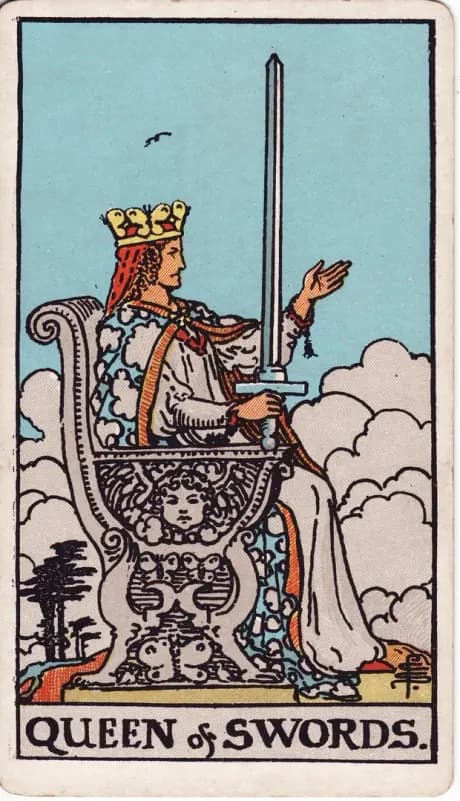
A crowned woman sits above a bank of cloud with her blade upright and one hand open, raised. Her subject is perception that has been paid for. Queens sustain their element rather than direct it, and what this one sustains is the capacity to see a thing exactly as it is and to say so without flinching and without gloating.
Swords is the suit of thought, language and conflict, and among its court she is the figure who uses those instruments to see rather than to win.
Upright she is the standard of honest judgement. She separates what happened from what it felt like, holds a boundary that does not need renegotiating every week, and asks the question everybody else has tacitly agreed not to ask. She is also the deck's clearest picture of independence chosen rather than suffered.
Reversed the same faculty turns inward and sours. Criticism used as a weapon. Isolation defended as discernment. A conclusion reached years ago and applied to everyone met since. Or the quieter version: somebody so worn down by being the sensible one that clear sight is the only thing they have left.
At work she is the editor, the auditor, the lawyer, the friend who tells you the plan is weak while there is still time to change it. Her value is that she will say the unpopular accurate thing in a room that would rather not hear it. Her cost is that she will say it in that room, out loud, during the meeting.
In creative work she is the second pass and never the first. She has no interest in generating material and unusual skill at cutting it.
Her characteristic mistake is assuming other people can take the truth as plainly as she can hand it over. Often they cannot, and the accuracy gets wasted on the delivery.
Queen of Swords as a yes or no
As a yes or no, the Queen of Swords upright is a conditional yes: yes, if the situation is honest. She does not bless anything that requires you to look away from part of it. Where the question is clean, she answers yes. Where the question depends on a detail you have been avoiding, she hands you the detail instead of the answer.
That makes her one of the more demanding cards to receive on a straight yes-or-no, because she keeps giving the question back. Ask whether he wants you and she replies with what you already know about how he behaves. The information is in your possession. She is pointing out that you have it.
Reversed she is a no, and the reason is usually internal rather than external: the position is being taken from an old injury rather than from current facts, or bitterness has already picked the answer and is now assembling support for it. It can also be a plain warning that a person or an arrangement will turn out colder than you are hoping.
If you want a clean answer from this card, sharpen the question. Not "will this work" but "is any part of this arrangement dependent on me not saying something". She answers the second kind with precision, and she answers the first kind with a raised eyebrow.
Queen of Swords as advice
As advice, the Queen of Swords says say the true sentence and stop managing everyone's reaction to it. Write it down first if you need to. Say it once, plainly, without the four qualifiers you were planning to attach, and then be quiet long enough for the other person to answer it.
The concrete version depends on where you are stuck. If you are waiting for somebody to notice something, tell them instead. If you have softened a request until it no longer contains the request, restore the original wording. If there is a fact you keep leaving out of your own account of the situation, put it back in — that one is usually the entire exercise.
She also advises the unpopular half: hold the boundary you already set. Not a new and harder boundary. The one you named and then quietly stopped enforcing because enforcing it was awkward. A limit that is renegotiated every time it gets tested is not a limit, it is an opening bid.
Reversed, the advice points at you rather than at the situation. Check whether the position you are defending is about the person in front of you or about somebody who is not in the room. Cynicism is extremely good at feeling like wisdom, and the tell is simple: it produces the same conclusion regardless of the input.
What she never advises is the hint, the test, or the loyal silence. All three are ways of hoping a difficult sentence will say itself, and it will not.
Queen of Swords as an outcome
As an outcome, the Queen of Swords ends the situation in clarity rather than in warmth. You will know what is true. Whether you like what is true is a separate matter, and this card does not comment on it.
Upright, this usually means the fog lifts because something finally gets said. A conversation happens, a position is stated, a decision that had been avoided is made and then held. Outcomes under this card tend to be stable, because a thing decided with the eyes open does not need re-deciding every month. If you were hoping for reconciliation and drew this, read it carefully: it does not rule that out, but it says any reconciliation will be built on an honest accounting rather than on a good weekend.
She is also, plainly, one of the deck's cards for ending up single by choice and being fine. That reading gets softened constantly and it should not be. Sometimes the outcome is that you decline the situation, and this card treats declining as a success.
Reversed as an outcome is colder. It resolves into distance: a position hardened, contact reduced, a decision made from an old wound rather than from present facts. Nobody is lied to and nobody is happy. If several Swords fall around her, that is the reading. If Cups or Pentacles surround her, the reversal is more likely to be exhaustion than bitterness, and exhaustion recovers.
What the Queen of Swords card shows
The 1909 card shows a crowned woman seated in profile on a heavy stone throne, facing the viewer's right, above a bank of cloud. She is the only Queen in the deck drawn entirely in profile, and the effect is that she is looking at something outside the frame rather than at you.
Her sword is upright in her right hand, vertical, held rather than brandished. The point goes to the sky. Each court card in this suit carries the blade differently and hers is the stillest: not raised to strike, not lowered to rest, simply up.
Her left hand is the detail most people miss. It is open, palm up, fingers slightly spread, lifted toward the empty space in front of her. It can be read as beckoning or as a request for somebody to speak, and either way it means the same thing. She is holding a weapon and asking for a sentence at the same time.
Her crown is set with butterflies. Butterflies are the air motif of this suit and they return on her throne, carved at the base and again at the crest. On the side of the throne is a winged child's head, a sylph, the spirit of air in the old system and the softest figure anywhere near her.
She sits above the cloud line, at the height where the sky is clear. Below and behind her the cloud is piled thick. A single bird crosses the upper sky. One dark tree stands at the lower left, small and far off.
Her expression is level. She is not sad and she is not severe. She is paying attention.
Frequently asked
What does the Queen of Swords mean as feelings?
+
Clear-eyed, boundaried interest — feelings filtered through honesty and judgment. Chosen, not fallen into. With this Queen, interest gets tested against evidence before it is spent, which makes it slower to appear and considerably harder to lose once it has.
Is the Queen of Swords cold in love?
+
Precise, not heartless. She loves with standards and truth; the chill is quality control. What reads as coldness is usually just the absence of pretending — she will not perform a feeling she does not have, including for your comfort.
Is the Queen of Swords a yes or a no?
+
Upright, a conditional yes: yes if the situation is honest, and a returned question if it is not. Reversed, a no, usually because the answer is being decided by an old injury rather than by the present facts.
What should I do when I draw the Queen of Swords?
+
Say the true sentence once, without the qualifiers, then stop talking long enough to hear the answer. After that, enforce the boundary you already named and quietly stopped enforcing. Both halves are the card; people usually do only the first.
Does the Queen of Swords mean a specific woman?
+
Sometimes — a direct, independent person of any gender who has been through something and does not decorate the truth. Just as often it is a quality being asked of you rather than a person in the story. Check whether the description fits anyone you actually know before you assign it.