What Queen of Wands means in tarot — and in love
The Queen of Wands is desire with a spine: confident, warm, magnetic — the energy of knowing your worth and enjoying being wanted. As feelings, the Queen of Wands means captivated admiration — they find you radiant, desirable, slightly untouchable in the best way.
Jump to FAQAt a glance
- Yes or no
- Yes — reversed flips it
- Element
- Fire
- Upright, in a line
- confidence, warmth, being desired for your fire
- Reversed, in a line
- jealousy, dimming yourself for someone
Want a yes or no on your own situation rather than this card? Pull one card and get the verdict with the reason behind it.
Ask your own yes-or-no questionUpright in love
The Queen of Wands is desire with a spine: confident, warm, magnetic — the energy of knowing your worth and enjoying being wanted. She signals a relationship where attraction and independence coexist, or a person whose fire draws the room. If you asked how to win here: bring your full self. This Queen mates with equals, not audiences.
In a new connection she describes someone who is interested without being available in the anxious sense. The attention is real and it is not desperate, which is a combination people often misread as coolness. It is not coolness. It is a person who has a life and would like you in it rather than a person who needs you to fill one.
In an established relationship she marks the version of the couple where both people are still themselves. Nobody has shrunk. There is warmth and there is also friction, because two people who have not shrunk occasionally collide, and that collision is what keeps the attraction from going flat.
Where the card carries a warning, it is a gentle one and it points at you. The Queen of Wands does not respond well to being managed, and she does not respond at all to being competed with by someone who has decided to be a smaller version of themselves to seem safer. If you are dimming to be chosen here, you are working against the exact quality that is doing the choosing.
The practical instruction is unusually simple: be more yourself, not less, and find out quickly whether that is what is wanted. It usually is.
Reversed in love
Reversed, the Queen of Wands is fire turned inward or sideways: jealousy, comparison, dimming yourself to keep someone comfortable, or a partner whose confidence curdles into drama. The remedy is reclaimed shine — your glow was never the problem.
The inward version is the more common and the quieter one. It looks like someone who used to take up space and has gradually stopped, usually without a single decision anywhere that you could point at. The confidence did not collapse; it was spent, in small amounts, on making someone else comfortable. Reversed, the card is naming that trade and asking whether it was ever agreed to out loud.
The sideways version is louder. Here the fire is intact and aimed at the wrong target: comparison with other people, jealousy that arrives as accusation, a need for reassurance that is never quite satisfied because the reassurance is not what is actually missing. Under it there is almost always insecurity rather than possessiveness, which matters because those two respond to completely different things.
There is a third reading worth naming because people miss it. Sometimes the reversal describes someone whose warmth has become performance — charming in the room, absent outside it. The heat is real in company and does not exist in private.
The move in all three versions is the same and it is not confrontation. It is one act of being fully yourself in front of the person, and watching precisely what happens next.
Queen of Wands As feelings
As feelings, the Queen of Wands means captivated admiration — they find you radiant, desirable, slightly untouchable in the best way. Attraction mixed with respect. You're the one they describe with their hands moving.
If you are single and asking about someone new. They are drawn to you and part of what draws them is that you do not seem to need them. This is genuine attraction with an element of admiration in it, which is a stronger foundation than pure desire and a slower-moving one.
If you are in a relationship. They still see you as the person they were first impressed by, which after a long time together is not a small thing. There may also be pride attached — they like being with you in front of other people, and that is not vanity, it is a form of affection this Queen expresses easily.
If you are asking about an ex. What they remember is your confidence, and they remember it as the best part. That is a warm memory and it is also an uncomfortable one for them, because it usually sits next to a sense that they were not quite equal to it.
If you are asking about someone long-term. Steady, warm, unanxious wanting. This is one of the least tormented feeling-cards in the deck. Whatever else is happening, they are not agonising.
Across all four, the constant is respect. This card never describes someone who feels superior to you.
Queen of Wands For your ex
For an ex, the Queen of Wands means your glow lingers in their memory — confidence is what they recall and what they'd return for. Any comeback conversation goes best from your throne, not your knees.
The specific memory this card describes is not of a moment but of a quality. They do not primarily remember what you did; they remember what you were like, and what you were like was self-possessed. That is why appeals made from a position of need land so badly here. They are not just unpersuasive, they contradict the thing being missed.
If contact comes, expect it to be confident rather than tentative — a direct message, an invitation, something with a little heat in it. This Queen does not do the drafted-and-deleted approach. That directness can read as certainty about wanting you back; it is usually just how she communicates, and the question of what she actually wants is separate.
The useful posture is symmetrical. Answer warmly, without hurry, from a life that is visibly still yours. Not as a strategy — as an accurate description of where you should be standing before any of this is worth having.
What Queen of Wands means in general
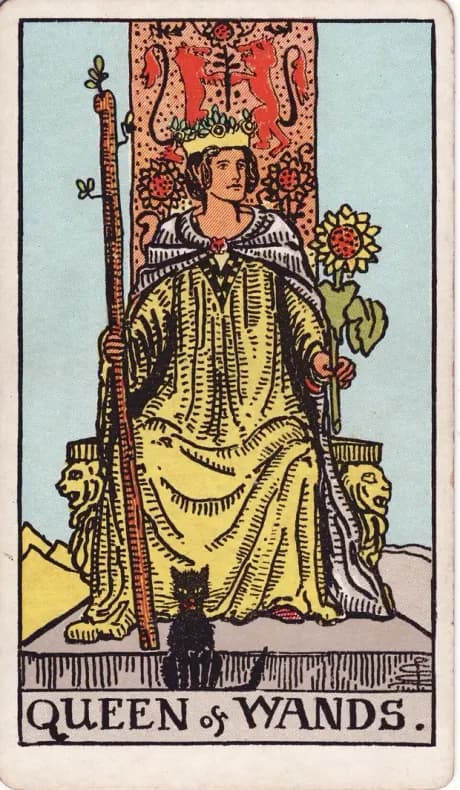
The Queen of Wands sits facing forward with a sunflower and a black cat: warmth on display, instinct beside her. Her subject is confident, magnetic authority — a person who is entirely themselves in public and expects the same of everyone else.
Upright she is competence that does not need to announce itself. She gets things done through people rather than around them, and the reason people cooperate is that she is genuinely warm rather than merely persuasive. In any situation, her card says the way through is charisma plus follow-through, in that order.
Reversed the same energy goes brittle. Confidence becomes performance, warmth becomes conditional, and the sensitivity that made her good at reading a room turns into reading it for threats. The reversed Queen can also describe someone whose fire is entirely spent — burnt out rather than dimmed by anyone else.
Outside the personal, she behaves consistently. In work she is the leader people follow because they want to, not because of the title. In creative life she is the one whose taste is the strongest asset. In money she is comfortable with risk and bad at caution, which is an advantage often enough to be worth its cost.
Among the four Queens, each holds authority differently: Cups through empathy, Swords through clarity, Pentacles through provision. Wands holds it through presence — the simple fact of being unmistakably herself in a room.
The black cat at her feet is worth noting as the card's one note of privacy. Everything else about her is visible; the instinct is not.
Queen of Wands as a yes or no
As a yes or no, the Queen of Wands upright is a yes, and a warm one. The situation is favoured, and it is favoured because of something you already have rather than something you need to acquire. If you asked whether you are wanted, whether you will be chosen, whether the confidence is justified — yes.
There is a condition folded into the yes, and it is characteristic of this card. The yes holds while you are being yourself. This Queen does not endorse a plan that depends on you performing a smaller or safer version of you in order to be acceptable. Where such a plan is what you asked about, the card reads much more ambiguously, and the honest translation is "yes, but not like that".
Reversed it becomes a no, and the flavour is depletion rather than refusal. The energy required is not currently available, or it is being spent somewhere that is not returning it. A reversed Queen of Wands on a yes-or-no question often means the answer would be yes if you were not this tired, which is a more useful thing to hear than a flat refusal.
On timing the card is moderately fast — quicker than Pentacles, slower than the Knight of her own suit, and dependent on someone deciding rather than on events unfolding.
Queen of Wands as advice
As advice, the Queen of Wands says: take up your full space and let people react to it. Not perform confidence — occupy it. The card's specific instruction is to stop pre-shrinking for an audience that has not asked you to, which almost everyone does more than they notice.
Concretely that usually means saying the thing directly. Naming what you want instead of arranging the conditions in which someone might guess it. Wearing, saying, doing the version that is actually you rather than the version calculated to be least objectionable. The card's claim is that the calculation costs you more than the objection ever would.
There is a second instruction about warmth, and it is the one people skip. This Queen's authority is not coldness — it is confidence with generosity attached. Being unbothered is not the goal. Being fully present, interested in people, and unwilling to make yourself smaller is.
Reversed, the advice changes to rest. The reversed Queen is nearly always someone running on empty and treating that as a character flaw. The instruction is not to try harder; it is to stop, refill, and notice where the energy has been going. Much of what looks like lost confidence is simply depletion, and depletion responds to rest rather than to resolve.
Queen of Wands as an outcome
As an outcome, the Queen of Wands is a situation that ends with you more yourself than you started. That sounds abstract and it is usually very concrete: you said the thing, held the position, stopped auditioning, and the situation reorganised itself around that.
In a love question this often means being chosen for the right reason — not because you were accommodating but because you were interesting. The relationships that arrive under this card tend to be the ones where both people kept their own shape, and the outcome is less "we merged" than "we fit".
It can also mean a situation ends with someone else's admiration and nothing more. This Queen is admired easily and pursued less often than the intensity of the admiration suggests, because people are occasionally intimidated by exactly what attracts them. If your question was whether they will act, look at the surrounding cards for a Knight or an Ace; without one, admiration may be the whole of it.
Reversed as an outcome is burnout or a slow dimming. The situation resolves with you having spent more than you got back, or having quietly become a smaller version of yourself in order to keep it. That reading is uncomfortable and it is worth taking literally rather than softening, because it is describing a cost that accumulated without a decision anywhere.
What the Queen of Wands card shows
The 1909 card shows a crowned woman on a stone throne, facing forward and looking slightly to her right. She holds a flowering wand in one hand and a large sunflower in the other, and a black cat sits at her feet, staring directly out at the viewer.
The throne is carved with lions and the back panel behind her carries sunflowers again. Lions here are the fixed fire sign, and the repetition matters: this is not a momentary heat like the Knight's, it is a settled, permanent quality. The heat is the furniture, not the weather.
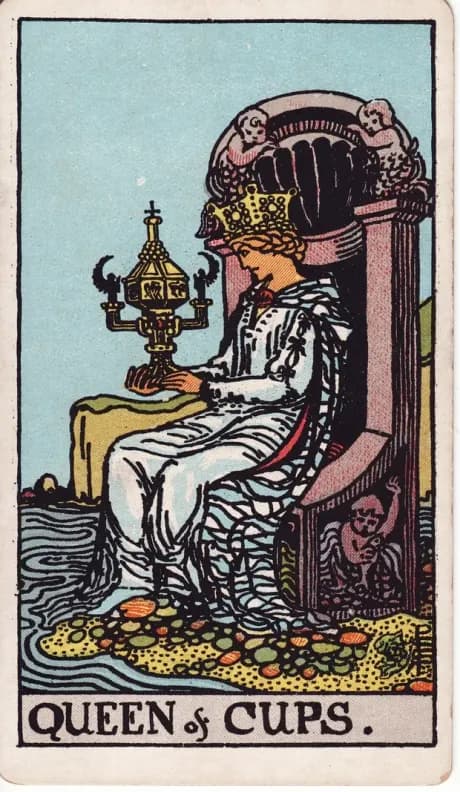
Her posture is the detail that carries the card. Her knees are apart, her feet are planted, and she takes up the full width of the seat. Compare that to the Queen of Cups, who is drawn compact and inward-turning. This Queen occupies her space without apology, and that is the argument the picture is making.
The sunflower is doing double work. It is a symbol of life and admiration, and it is also a flower that physically turns to follow the sun — a plant that orients toward what it wants, visibly and without embarrassment.
The black cat is the only element that is not warm, bright or open, and it is the only thing looking straight at you. Traditionally it is read as instinct, the private and slightly wild part that sits beneath the public warmth. Everything else in the card is on display. The cat is the part that is not.
The background is bare desert under a pale sky — the same empty ground the whole suit stands on.
Frequently asked
What does the Queen of Wands mean in love?
+
Confidence that attracts without chasing. It describes a person, or a version of you, who is warm and self-possessed at the same time — and a connection where both people keep their own shape rather than one shrinking to fit.
Does the Queen of Wands mean someone is attracted to me?
+
Yes, and with respect in it rather than only desire. This card describes admiration — being found impressive as well as wanted. It is one of the least anxious attraction cards in the deck.
Is the Queen of Wands a yes or a no?
+
Upright it is a warm yes, with one condition attached: the yes holds while you are being yourself rather than a smaller version calculated to be acceptable. Reversed it is a no of depletion — the answer would be yes if you were not this tired.
What should I do when I draw the Queen of Wands?
+
Take up your full space and say the thing directly, rather than arranging conditions in which someone might guess it. Reversed, do the opposite of trying harder: rest, and notice where your energy has been going.
What does the black cat on the Queen of Wands mean?
+
Instinct, and privacy. Everything else in the card is bright, open and on display; the cat is the only element that is dark and the only one looking straight at the viewer. It is the part of her that is not public.