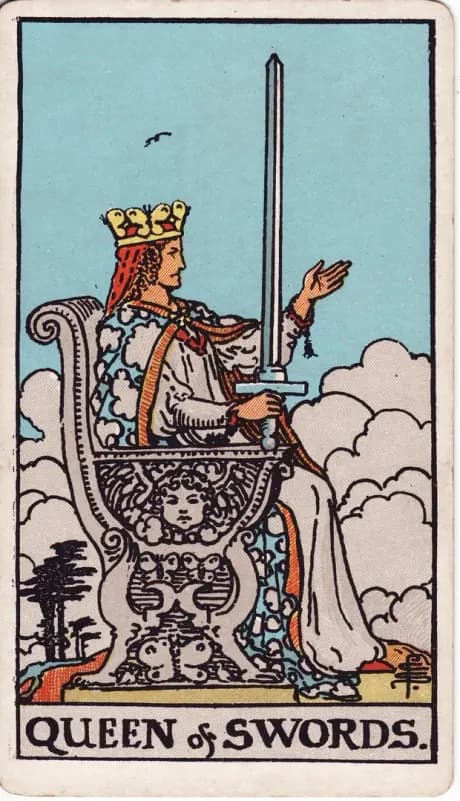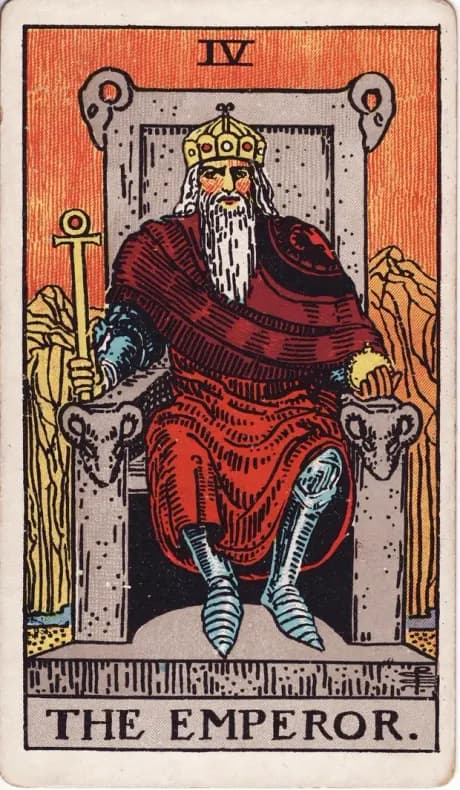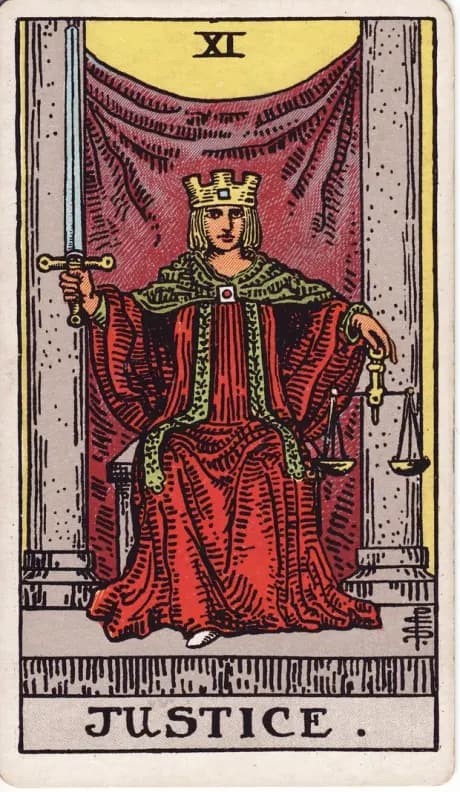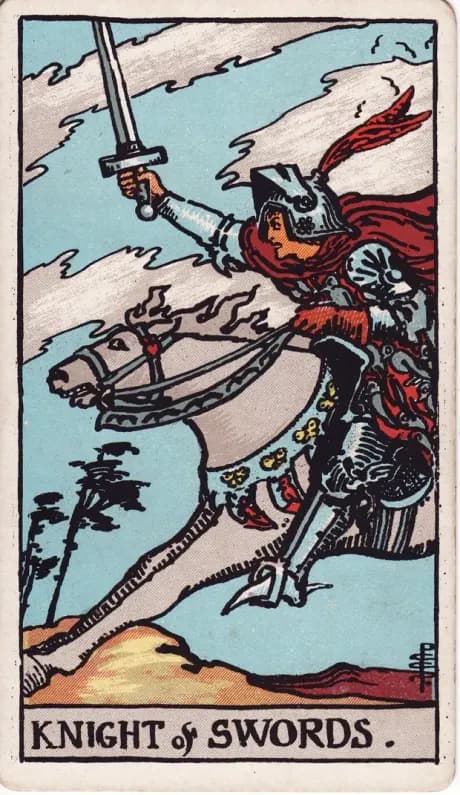
What King of Swords means in tarot — and in love
The King of Swords is love under jurisdiction: rational, principled, honest to a fault — a partner who leads with logic and keeps every promise he… As feelings, the King of Swords means controlled regard — they respect you, evaluate the relationship logically, and keep emotion behind procedure.
Jump to FAQAt a glance
- Yes or no
- No — reversed flips it
- Element
- Air
- Upright, in a line
- rational judgment, truth over drama
- Reversed, in a line
- coldness, intellect weaponized
Want a yes or no on your own situation rather than this card? Pull one card and get the verdict with the reason behind it.
Ask your own yes-or-no questionUpright in love
The King of Swords is love under jurisdiction: rational, principled, honest to a fault — a partner who leads with logic and keeps every promise he actually makes. Expect clear terms, fair fights, and affection expressed through reliability. If you asked about their intentions: whatever he stated is the truth. The fine print is the romance.
The distinctive quality here is that nothing is implied. This King says what he means and means only what he said, which is disorienting for anyone used to reading between lines, because there is nothing between the lines. People frequently experience that as coldness at first and as enormous relief a year later.
In a new connection he is slow to declare and exact once he does. He will not manufacture enthusiasm he does not feel, and he will not tell you he is unsure in a way designed to keep you waiting. If he says he is not looking for anything serious, that is not a challenge to be overcome; it is a statement of fact.
In an established relationship he is the partner who handles things. Practical problems get solved, arguments have rules, and the promises made three years ago are still being kept without anyone having to check. The affection is real and it is expressed as dependability rather than as language.
The thing to ask for with this card is not more feeling but more articulation of the feeling that already exists. It is usually there in quantity and considered too obvious to say. Asking directly works; hinting does not, because hinting is a form of communication he does not receive.
Reversed in love
Reversed, the King of Swords is logic weaponized: emotional unavailability defended with arguments, coldness enforced as policy, intellect used to win rather than understand. Feelings dismissed as inefficiencies. You cannot cross-examine someone into warmth. If the verdict is always against you, change courts.
The characteristic move of the reversed King is the technically correct answer that misses the entire point. You raise something that hurt you and receive a precise account of why it was reasonable. Nothing in the response is false and none of it addresses what you said. Over time this teaches the other person not to raise things, which is usually the function it was serving.
The second version is judgement without warmth: a partner who has appointed himself the arbiter of what is reasonable, and whose standards are applied to you and not to himself. Criticism delivered as objectivity is still criticism, and the objectivity framing makes it much harder to answer.
There is a gentler third reading, and it is worth checking before assuming the worst. Sometimes the reversal is simply a person under strain who has retreated into their head because that is where they feel competent. That looks identical from outside and responds completely differently — to patience rather than to confrontation.
The practical distinction between the versions is whether he can ever be moved by something that is not an argument. If a plainly stated feeling changes anything, this is the third version. If only evidence moves him and feelings are always ruled inadmissible, it is the first.
King of Swords As feelings
As feelings, the King of Swords means controlled regard — they respect you, evaluate the relationship logically, and keep emotion behind procedure. What's felt is real but rationed. Words will be precise; read them exactly.
If you are single and asking about someone new. He has an opinion of you and it is favourable, and he has not decided to act on it, because acting is a decision and decisions get made carefully here. Read what he actually says rather than what the tone suggests; the tone carries less information than usual with this card.
If you are in a relationship. Respect, and a settled position. He has thought about the relationship and concluded it is right. That conclusion is stable in a way that a feeling is not, which is the underrated strength of being loved by this card.
If you are asking about an ex. A reasoned position exists, and it has probably not changed since the last time you spoke. This is the card of the person who worked out what he thinks and then closed the matter. Emotional appeals will not reopen it; genuinely new facts sometimes will.
If you are asking about someone long-term. Loyalty expressed as continuity rather than as demonstration. He would find it strange to be asked whether he still feels the same, because to him the question was settled and settled things do not require re-announcing.
Across all four: real feeling, deliberately regulated, and easy to underestimate.
King of Swords For your ex
For an ex, the King of Swords means the case is decided on evidence: they hold a reasoned position about you two. Emotional appeals bounce; changed facts persuade. Reopen negotiations only with genuinely new material.
The frustrating property of this card is that the position is not a mood. You cannot wait for it to soften, because it was not arrived at by feeling and will not be revised by feeling. He thought about the relationship, reached a conclusion, and the conclusion is now simply what he thinks.
That has one useful implication. Where most ex-cards reward patience or timing, this one rewards information. If something material has genuinely changed — a circumstance, a behaviour with a track record behind it, a problem that has been solved rather than promised — that is the kind of input this King processes. A long message about how much you miss him is not.
It also means the door is less likely to be quietly ajar than with other courts. If he ended it, he ended it, and the absence of contact is not ambivalence. What looks like coldness is usually just the consistency of someone who does not maintain positions he has abandoned.
What King of Swords means in general
The King of Swords sits facing forward with his blade vertical: judgement in its most impersonal form. His subject is intellectual authority — the decision made on evidence, the rule applied consistently, the person you want in the room when the situation requires clarity rather than comfort.
Upright he is fairness. Not kindness, which is a different quality, but the genuine article: the same standard applied regardless of who it favours, including himself. He is also the card of expertise, of the specialist whose opinion is worth more than the consensus in the room.
Reversed the same faculty turns predatory or brittle. Argument used to dominate, standards applied selectively, cynicism mistaken for realism, or a mind so committed to being right that it can no longer notice new information.
Outside the personal, the card is consistent. In work it is the lawyer, the analyst, the auditor, the person who reads the contract. In conflict it is arbitration. In decisions it is the argument for choosing on merit and living with the result.
Among the four Kings, each rules through a different faculty: Cups through emotional steadiness, Wands through will, Pentacles through provision. Swords rules through judgement, and it is the only one of the four whose authority does not depend on anyone liking him.
The card carries one consistent warning. Clarity is not the same as being right, and a well-constructed argument can be entirely wrong. This King's characteristic failure is not stupidity; it is certainty that arrived early and stopped updating.
King of Swords as a yes or no
As a yes or no, the King of Swords upright is a conditional yes: yes, if the facts support it. That sounds evasive and it is actually the most precise answer this card can give, because the King's whole nature is that his verdict follows the evidence rather than preceding it.
In practice, treat it as a yes with a demand attached. The situation will go your way if your case is genuinely sound, and it will not if you are hoping charm or persistence closes a gap that logic leaves open. Where a querent is honest with themselves, most people know which of those they are in.
There is a second common reading. Sometimes this card answers by telling you that the decision is not yours — it rests with someone else, and that someone decides on merit. That is useful information and it points at the same action: strengthen the case rather than the appeal.
Reversed it becomes a no, and the character of the no is coldness or a decision already made against you. The reversed King has closed the matter, and continuing to argue makes the position more entrenched rather than less. If you get this on a question about persuading someone, the answer includes the method: stop persuading.
King of Swords as advice
As advice, the King of Swords says: decide on the evidence and say the decision out loud. The card is unusually specific about method. Write down what you actually know, separate it from what you assume, and make the call on the first list rather than the second.
The second instruction concerns honesty and it is the harder half. This King advises saying the true thing plainly, including when it is unwelcome, and including when a softer version would be easier for everyone in the room. The card's position is that ambiguity extended out of kindness is a debt somebody pays later with interest.
For a relationship question this usually means stating your actual terms. Not hinting at them, not testing whether they are guessed, not hoping the situation resolves without anyone having to be explicit. What do you need, what will you not accept, said in sentences. This is uncomfortable and it is the entire recommendation.
Reversed, the advice inverts and becomes about restraint. Stop arguing. You are winning exchanges and losing the thing the exchanges were about. The reversed King's counsel is to notice when being right has stopped serving any purpose you actually care about, and to let one point go undefended on purpose.
King of Swords as an outcome
As an outcome, the King of Swords is a situation that resolves by decision rather than by drift. Someone chooses, states it, and the matter closes. Whether the choice favours you depends on the surrounding cards, but the character of the ending is consistent: clear, reasoned and final.
In love questions this frequently means a conversation where terms get set. Not a fight — a settlement. Somebody says what they want and what they are prepared to offer, and the ambiguity that has been running the situation ends. People often find this outcome colder than they hoped and more useful than they expected.
It can also mean the outcome is determined by a third party or by a rule rather than by either person's feelings. In practical questions this is literal: a contract, a ruling, an official decision.
Reversed as an outcome is harsher. The situation ends in a verdict delivered without warmth, or in an argument that one party wins and both lose. It can also mean an outcome dictated by someone whose judgement is not as sound as their confidence suggests. Where that is the reading, the card's advice is not to appeal but to stop presenting a case to a court that has already decided.
What the King of Swords card shows
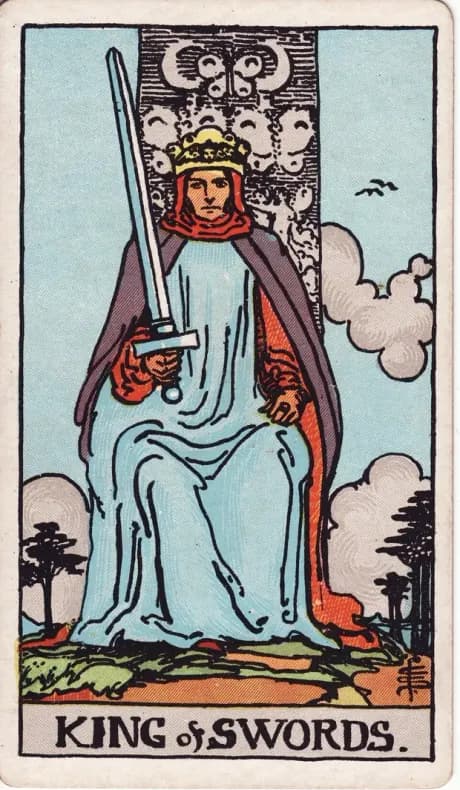
The 1909 card shows a crowned man on a stone throne, facing directly forward, holding a sword upright in his right hand. He is the only King in the deck drawn fully frontal, meeting the viewer's eyes without any turn of the body.
The sword is the detail that carries the reading. It is held vertical but tilted very slightly to his right, not perfectly straight. Read the picture literally and the card's own caution is drawn into it: even this figure's judgement is a fraction off true, and he does not know it.
His throne is carved with butterflies and with a crescent moon, and two more butterflies appear on the back panel. Butterflies are transformation through air — thought changing form. They are the softest symbol in an otherwise severe picture, and their presence argues that this mind is capable of changing, whatever the posture suggests.
The sky behind him is grey and the clouds are gathered rather than moving. Two birds fly high and small at the top right — far fewer than the Page's scattered ten. Thoughts here are few and high.
The trees at the horizon bend slightly, so there is wind, but nothing near him moves: his robe hangs still, his crown sits level. He is the one fixed object in a moving element.
His robe is blue-grey and his cloak is a deep, saturated red, mostly hidden behind him. The passion is present in the picture and it is entirely behind the figure, out of the way of the work.
Frequently asked
What does the King of Swords mean in love?
+
A partner who leads with logic and keeps the promises he actually makes. Nothing is implied — he says what he means and means only that, which reads as coldness early and as reliability later. Affection is expressed as dependability rather than language.
Is the King of Swords emotionally unavailable?
+
Upright, no — the feeling is real and deliberately regulated. Reversed, that is exactly the risk: intellect used to win rather than understand, and feelings ruled inadmissible. The test is whether a plainly stated feeling ever changes anything.
Is the King of Swords a yes or a no?
+
A conditional yes: yes, if the facts support it. It answers on merit rather than on hope, so the practical translation is to strengthen the case rather than the appeal. Reversed it is a no from a decision already made.
What should I do when I draw the King of Swords?
+
State your actual terms in plain sentences — what you need and what you will not accept — rather than hinting and hoping they are guessed. Reversed, stop arguing: you are winning exchanges and losing what they were about.
How do I reach an ex who is the King of Swords?
+
With new information, not feeling. His position was reached by reasoning and will not be revised by emotion. Something materially changed — a circumstance, a behaviour with a track record — is the only input this card processes.